Continental Breakfast
Continental Breakfast
etn Newsletter | September 25, 2026

Happy Friday! Just a few stops left on our Europe tour before we head back to the studio. Inside today: how the US is stepping into Elon Musk’s fight with Brussels and an op-ed on the AI race Europe can win.
What’s Happening Today
Washington is stepping into Elon Musk's fight with Brussels.
The Justice Department has filed to intervene in Musk’s legal challenge against a €120 million EU fine. Brussels imposed the penalty in December, accusing X of deceptive blue-check practices, a lack of transparency around its ads and failing to give researchers access to platform data. It was the first such penalty under the EU’s Digital Services Act.
At issue is how that €120 million fine was imposed. The DOJ says the EU went too far by holding Musk and other US companies he controls liable. It is also questioning how the fine was calculated, arguing that Brussels used the revenue of the wider group controlled by Musk rather than X's alone.
Justice and State Departments coordinated the intervention, saying they have a broader interest in protecting US companies from foreign enforcement.
The fight comes as the EU continues to take action against big US tech companies. Apple is also appealing a separate €500 million fine under the Digital Markets Act. Meanwhile, Brussels is investigating X again over whether it properly assessed the risks of integrating Grok into the platform after the chatbot generated sexually explicit images.
Daily Op-Ed — The AI Race Europe Can Win
The easiest way to feel pessimistic about Europe's position in AI (as in life) is to compare yourself to everyone else.
The biggest models are American, the biggest AI companies are American and the amount of money going into ever-larger models is on a scale European firms cannot really match. As Mario Draghi highlighted in his 2024 report on European competitiveness, "only four of the world's top 50 tech companies are European. "If winning in AI means building the biggest brain in the cloud, the pessimists may be right.
But AI is now starting to move out of the browser and into the physical world and that changes the game. A model can pass the bar exam and score brilliantly on benchmarks, but none of that is much use to a factory if the robot cannot tell when a part has been fitted incorrectly.
The hard bit is getting a machine to do something useful, reliably, every day, inside a real production process. This is exactly where Europe's industrial base becomes an asset. Western European factories run a record 267 robots per 10,000 manufacturing workers, compared with 204 in North America, and Germany, at 449, ranks third in the world.
At etn. we interviewed the CEO of RobCo, a company spun out of the Technical University of Munich in 2020. It makes modular robots that can be taught tasks like machine tending and palletising by demonstration, then sells them as a subscription so smaller manufacturers can automate without needing a large engineering team.
This is the opportunity Europe should be thinking about. Whether we can become exceptionally good at putting AI to work in the real economy.
Europe already has an enormous industrial base to experiment on, from automotive plants to thousands of smaller manufacturers. Every machine deployed into those environments also generates the kind of real-world data that physical AI needs to get better.
The political scientist Jeffrey Ding has made a similar point about technological competition: the countries that benefit most from a technology are not always the ones that invent it, what matters is how widely they manage to adopt and diffuse it.
That feels particularly relevant to AI. Rather than spending billions trying to build a European OpenAI, Europe could focus on becoming the place where AI gets put to work most effectively in the physical economy.
— Lucas Dwyer
etn. Insight
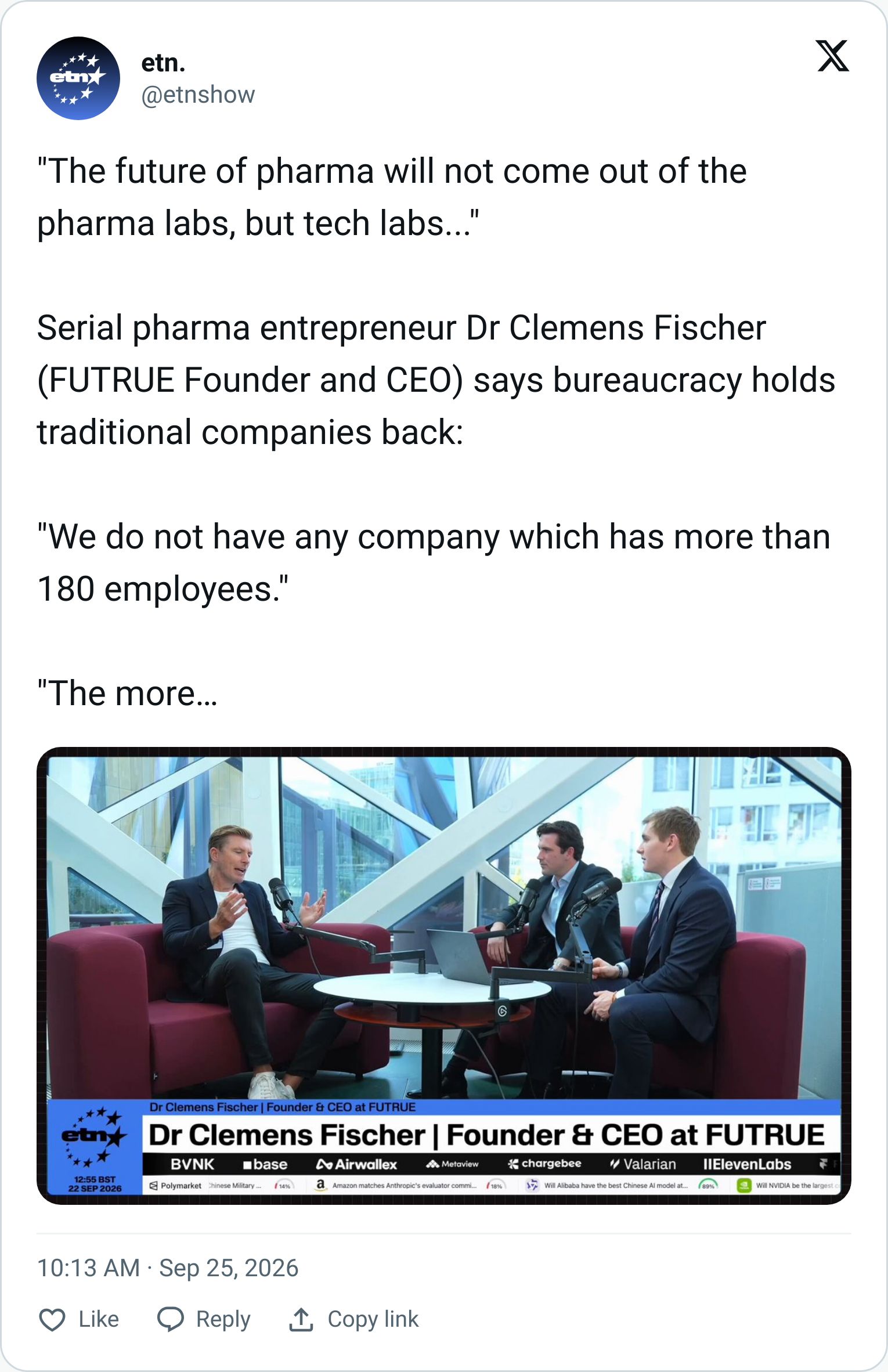
Serial pharma entrepreneur and FUTRUE CEO Dr Clemens Fischer joined us at HumanX and explained why he thinks the future of pharma will come from tech labs rather than traditional pharma companies.
He sees bureaucracy as a major problem for larger companies. “We do not have any company which has more than 180 employees.” Every time FUTRUE reaches around 170 to 180 people, “we just cut and start a new section.” The most efficient companies, he says, are “really small, (with) no bureaucracy.”
Watch the full clip below.
2026 ETN100
The ETN 100 The 100 people worth following on X.
European Technology Network •
