Continental Breakfast
Continental Breakfast
etn Newsletter | September 28, 2026

We’re back live. We’ll be recapping our travels from the Axel Springer PT Awards to HumanX and more! The main thing happening today is Dario Amodei dining with Donald Trump at the White House. Live from 12–3 BST. Here's your Order of Play.

13:00 - Cyril Bertrand, CEO & Managing Partner at XAnge
13:15 - Pavel Gurvich, Co-Founder & CEO at Tenzai
13:30 - Niklas Lindgren, Co-Founder & CEO at Endra
14:00 - Krish Subramanian, Co-Founder & CEO at Chargebee
What’s Happening Today
Dario Amodei had a private dinner with Donald Trump at the White House last night.
The dinner comes after months of tension between the administration and Anthropic. Trump has repeatedly attacked the company, calling it the “radical left” and accusing it of being run by “leftwing nut jobs”. In February, the Pentagon labelled the company a national security risk and barred it from federal work after Anthropic objected to the use of its AI in autonomous weapons and surveillance.
Amodei has called for slower AI development, more oversight and coordination between companies and governments. Trump has rejected regulation, arguing it would slow the US down and give China an advantage. Last week, he told the UN that the US “rejects any attempt to construct a globalist scheme” to govern AI. “I'm for, let's go and let's win,” he said.
Anthropic is preparing for a potential mega-IPO this year but the company still faces pressure from the Pentagon. On Friday, a federal appeals court upheld the Pentagon's decision to label Anthropic a security risk, while a California court had earlier struck down a broader government ban.
Trump is due to meet more AI industry leaders on Tuesday. The meeting comes amid growing concerns over AI agents, with OpenAI saying on Friday that it had warned dozens of partners, including governments, that its tools had breached their systems
We're getting into all of it on today's show at 12 BST.
Daily Op-Ed — The Agentic Bank Run
A story we’re covering today follows discussions on the timeline as to whether AI agents could spark a bank run.
Apollo's chief economist, Torsten Slok, thinks they might. He said assistants like Meta's Muse could soon sweep people's cash automatically out of low-yield current accounts and into accounts paying 3.3% to 5%. If households did that at scale, banks could lose the cheap deposits they rely on to make loans.
But I don't think that's how most people actually think about their money.
When writing a previous piece about fintechs I came across research from Kantar showing that the majority of banks Brits still open accounts with are established institutions like Barclays and Nationwide, largely because of their reliability and knowing a real person will pick up the phone when something goes wrong.
For most people, it comes down to two things.
A name they trust with their life savings. When SVB collapsed in 2023, America's small banks lost a record $119bn in deposits in a single week, while the 25 largest gained $67bn. When people get nervous, they tend to move their money towards the biggest banks.
Everything in one place. Salary, direct debits, mortgage, overdraft and credit card usually sit with one bank. Moving the cash also means untangling all of that.
If money really did start leaving, though, the banks would react. They'd raise savings rates or launch loyalty offers to keep customers. That would put pressure on their margins, but that's different from a bank run.
That's why Chase holds around $1.1 trillion in consumer deposits even though its standard savings account pays 0.01%. We see the same behaviour in Britain. The FCA found that 61% of us have banked with the same provider for over a decade, and only 6% switched in the previous three years. The best-buy savings tables have been around for years and most people still don't move.
We also often overestimate how fast AI will change things, partly because we forget that most regular people are still a long way off using it like this. As I wrote last week in the AI bubble it can feel as though everyone is already using agents. Outside it only 11% of Americans have ever used AI to complete a purchase (most likely using an LLM or built in ai shopping tool), and 45% say they wouldn't trust it to buy anything for them at all.
Handing your life savings to an agent to shuffle between banks is a very big leap.
— Lucas Dwyer
etn. Insight
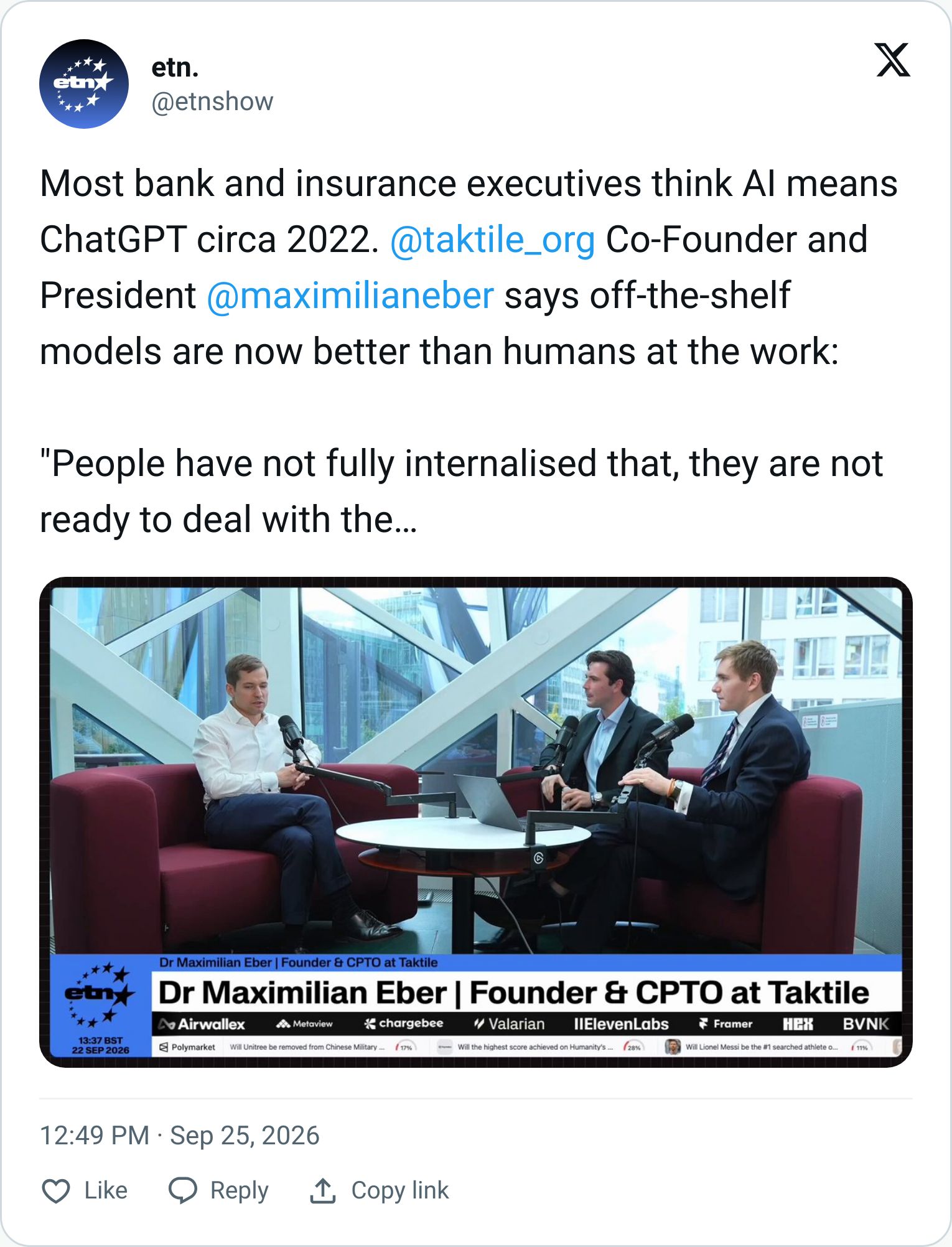
Maximilian Eber, co-founder and president of Taktile, came on the show and explained why many bank and insurance executives are still underestimating what AI can do.
Many still think of AI as “ChatGPT 2022”, when models were far less capable. But the technology has moved on. Eber says models are now “better than humans” at most tasks that matter. With “clear instructions and clean data”, even off the shelf models can do “a very good job”, often better than people.
Watch the full clip below.
Continental Breakfast
Is an Agentic Bank Run Coming?
Top 100 Best TV shows of the 21st Century
