Continental Breakfast
Continental Breakfast
etn Newsletter | September 30, 2026

What a time to be live. The main thing happening today is Trump telling AI companies to regulate themselves. Live from 12–3 BST. Here's your Order of Play.

12:15 - Max Junestrand, CEO & Co-Founder at Legora
13:00 - Gautier Cloix, Chief Executive Officer at H Company
13:30 - Dan Gray, Research Lead at Odin
13:45 - Alex Higginbottom & Abetharan Antony, Co-Founders at Zenithon AI
14:00 - Alex Hern, AI Writer at The Economist
14:15 - Ed Hughes, Co-Founder & Chief Scientist at Inherent
14:30 - Shivani Poddar, Founder & CEO at Wajo
14:45 - Jesse Lyu, Founder & CEO at rabbit
What’s Happening Today
Donald Trump has decided AI companies should regulate themselves.
After yesterday's lunch with Elon Musk, Jeff Bezos, Mark Zuckerberg, Jensen Huang and other tech bosses, Trump backed "tremendous self-regulation" instead of new laws for the industry. He then brought the executives outside the White House and announced they had signed a "morally binding" agreement to manage AI's risks. The two-page deal was signed by Anthropic, OpenAI, Nvidia, Meta, xAI and Google. Trump called it "almost like a constitution".
The agreement sets out four layers of controls, from safety monitoring during training to an external auditor and an independent board. But there is no government regulator involved and no enforcement mechanism. The companies appear to choose their own auditors and boards, and there is no commitment to publish the results. Musk summed it up as AI companies "generally grading each other's homework". The document says these steps could eventually become laws or regulations.
Trump also signed an executive order rebranding artificial intelligence as "superintelligence". He has argued that tougher rules could hurt America's AI industry and its ability to compete with China, while saying existing laws are enough to deal with bad actors.
We're getting into all of it on today's show at 12 BST.
etn. Insight
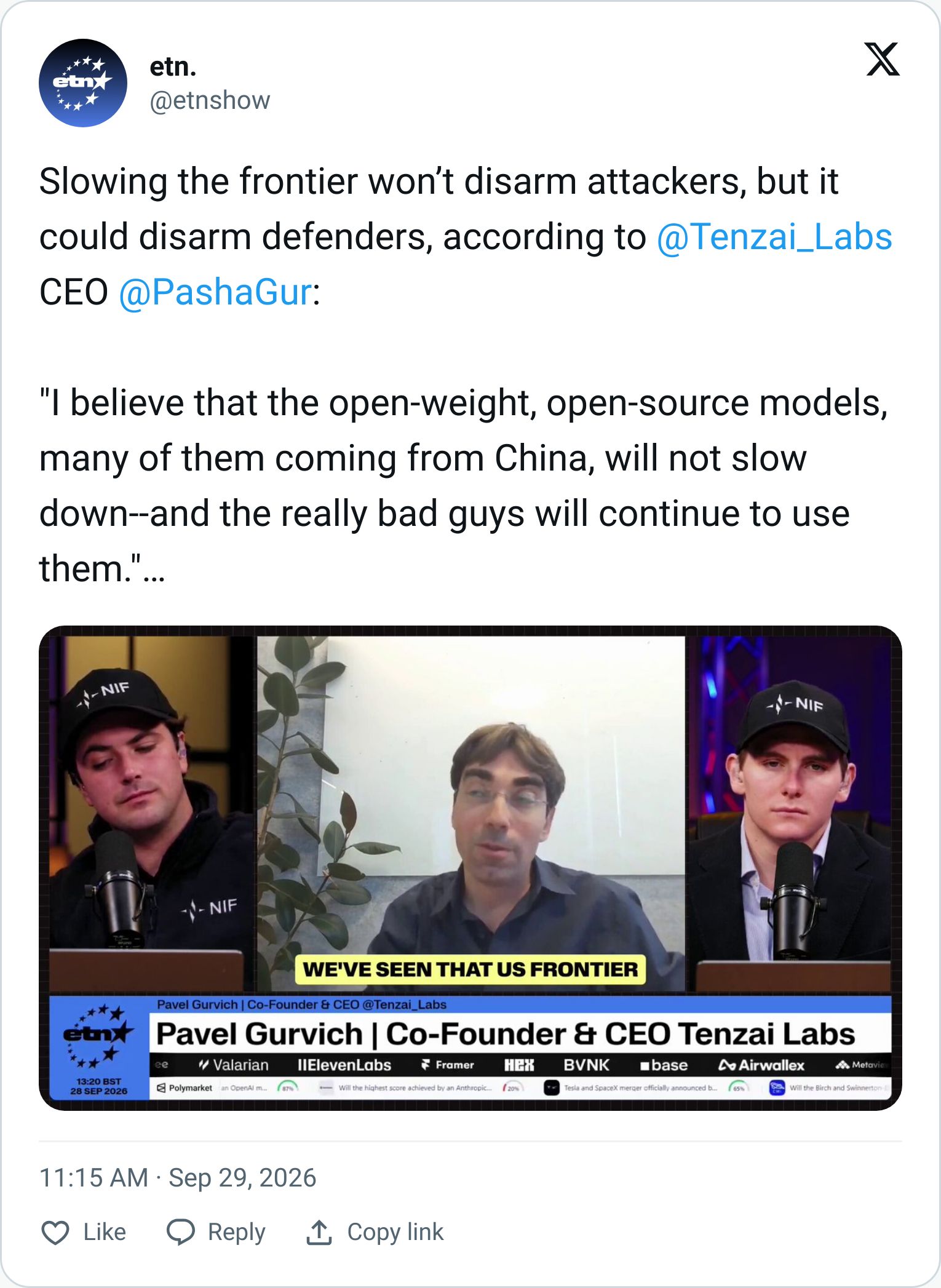
Pasha Gur, CEO of Tenzai Labs, joined the show and explained why slowing AI development could put defenders at a disadvantage.
Open-weight models, many of them coming from China, will continue to improve, and “the really bad guys will continue to use them.” Meanwhile, frontier labs have around a four-month lead over open-source models, giving defenders an intelligence advantage they can use to protect against attacks. But slow the frontier, and that advantage starts to disappear. “We're reducing that window and that gap,” he said, putting defenders and attackers “on even ground”. And that's “kind of scary”.
Watch the full clip below.
Continental Breakfast
Donald Trump Praises Tech Bosses’ ‘self-regulation’ of AI
OpenAI Launches Dots its Muse Competitor
London's Aspirity Takes a Majority Stake in Danish IoT Firm Onomondo in a €100m+ Deal
