Continental Breakfast
Continental Breakfast

What a time to be live. A slight delay to the show today but we’ll be live from 12:40! The main thing happening today is Factory accusing a former board adviser of leaking secrets to its biggest rival. Here's your Order of Play.

13:00 - Kaushik Subramanian, Partner at EQT Ventures
13:15 - Marcel Weekes, VP of Product Engineering at Figma
13:30 - Guillaume Princen, Head of EMEA at Anthropic
13:45 - David Paffenholz, Co-Founder & CEO at Juicebox
14:00 - Melissa Klinger, General Partner at DIG Ventures
14:15 - Shankar Krishnamoorthy, Chief Product Development Officer at Synopsys
What’s Happening Today
Factory has accused a former board adviser of leaking secrets to its biggest rival.
Matan Grinberg, Factory's co-founder and CEO, terminated Chris Degnan as a board adviser, accusing him of sharing confidential information with Cognition. Two hours later, Degnan announced he was joining Cognition as chief revenue officer. Degnan says he resigned from Factory to take the job and denies sharing any proprietary information.
Factory, which builds AI coding agents for enterprise engineering teams, raised $200 million at a $5 billion valuation in September, while Cognition, the company behind the coding agent Devin, raised $2 billion at $48 billion a week earlier. Grinberg says Degnan was asking about Factory's product roadmap and its "parity gap" while speaking to Cognition. Degnan insists his last board meeting was weeks before he had any contact with Cognition, and that Grinberg even offered him a full-time role as he left.
Khosla Ventures backs both companies, putting Vinod Khosla and his partner Keith Rabois on opposite sides of the dispute. Khosla accused Grinberg of lying and called Factory a "struggling second tier competitor", while Rabois backed Factory, arguing that interviewing with a rival while attending board meetings is "unethical per se". Cognition CEO Scott Wu, meanwhile, said his company had "no interest in Factory's info."
We're getting into all of it on today's show at 12 BST.
Daily Op-Ed — Why Are We Still on Hold?
Mati Staniszewski, co-founder of ElevenLabs, came into the studio on Tuesday for what was one of my favourite interviews on etn to date. Partly because ElevenLabs is one of those companies whose technology has real, everyday uses. AI that could actually make life easier for the everyday person.
Talking about the company's work with the UK government, he said that one day “you'll be able to get help and access to all the services through voice”. You could simply call and ask: “How do I renew my driving licence?”
Millions of people are still spending their time navigating government websites, filling in forms and waiting on phones. HMRC callers are waiting an average of 11 minutes to reach an adviser. The NHS waiting list had 7.3 million people on it in July.
Plenty of that comes down to admin. Where's my claim, can I move my appointment, what does this letter from my GP actually mean. Those are the questions voice agents now handle well, and they're the ones clogging up every phone line in the country.
ElevenLabs already does this elsewhere. In the Czech Republic, its agents take more than 5,000 calls a day about employment benefits that used to go unanswered. Put the same thing to use with the DVLA, the Passport Office and the 8am GP scramble, and millions of people get an afternoon back.
On the same day Mati was in our studio, the White House launched America.gov, an AI front door to federal services, with Marco Rubio demoing passport applications and Mehmet Oz booking Medicare doctors on stage.
That feels like where government should be heading.
We've got one of the world's best voice AI companies sitting in London. We've got millions of people who would benefit from not having to navigate the machinery of the state.
So why are are we still on hold?
— Lucas
etn. Insight
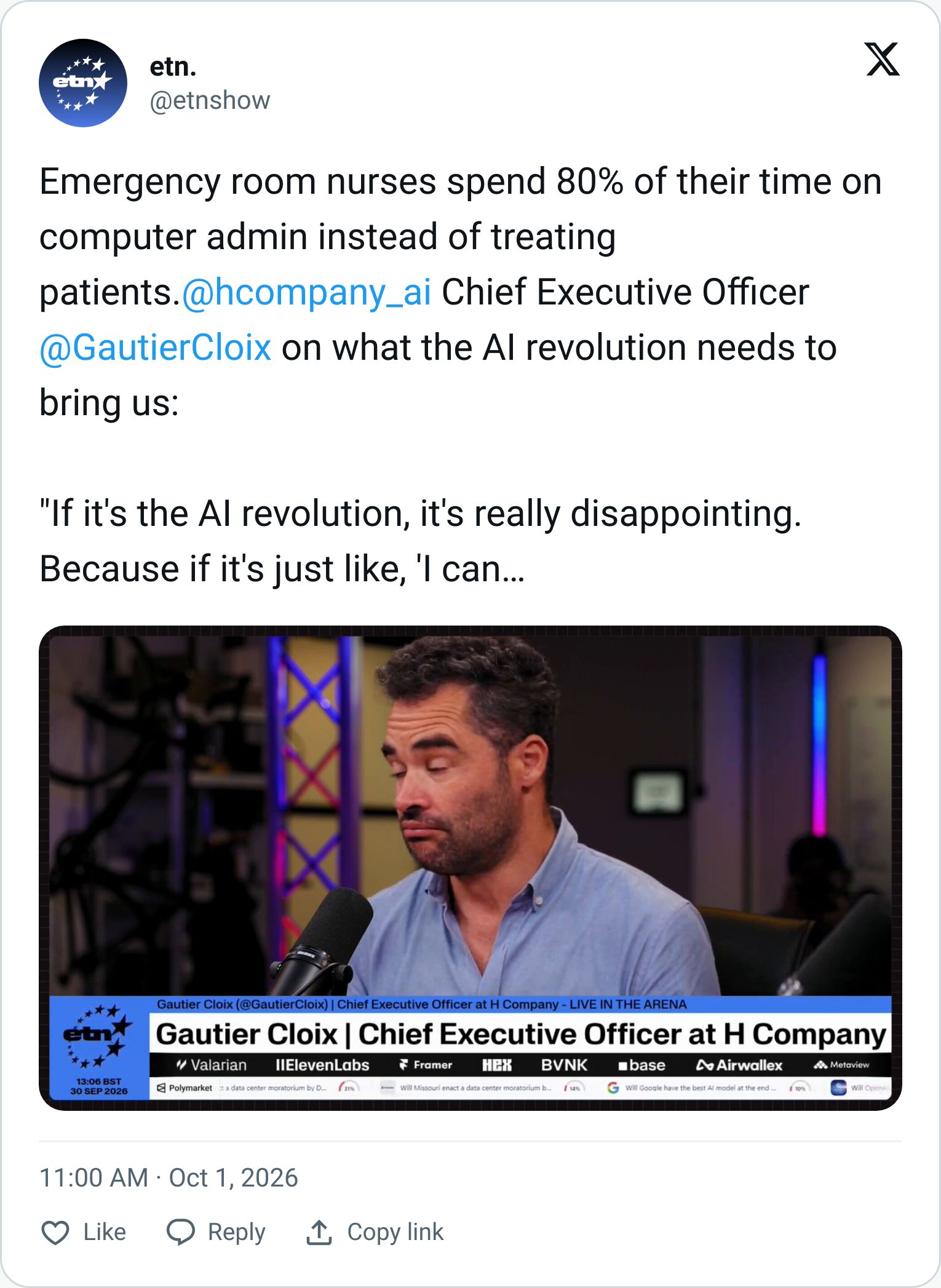
Gautier Cloix, CEO of H Company, joined the boys in the studio and argued the AI revolution has so far aimed far too low.
"If it's the AI revolution, it's really disappointing," he said. "If it's just like, 'I can make slides faster,' or 'I can book a hotel faster,' that's really disappointing."
Gautier used the example emergency room nurses, who he says spend 80% of their time on computer admin rather than patients. "A patient arrives, you log them on a tool, then there's another tool for diagnostics, so I need to copy and paste. Oh, I need to find a bed, there's no space. That's basically your day." The cost is real: "You've been trained to care for patients, but 20% of your time is doing that, 80% is doing all the rest. Which means you sometimes lose patients, and patience."
What the AI revolution actually needs, he said, is "real-world outcomes."
Watch the full clip below.
Continental Breakfast
Factory AI Accuses Cognition of Poaching Advisor
Google’s Argon Beats Astra & Fable
OpenAI says it shut down a big campaign to copy its models' hidden reasoning
