Continental Breakfast
Continental Breakfast
etn Newsletter | September 23, 2026

The team is live right now from HumanX in Amsterdam, and we have a stacked line up for you! The main thing happening today is discussions around AI at the UN. Here's your Order of Play.

11:45 - Stefan Weitz, Co-Founder & CEO at HumanX
12:00 - Stephan Pretorius, Chief Technology Officer at WPP
12:15 - James Wise, Partner at Balderton Capital
12:30 - Tom Eggemeier, CEO at Zendesk
12:45 - Max Welling, CTO & Co-Founder at CuspAI
13:00 - Xuedong Huang, CTO at Zoom
13:15 - Timothy Young, CEO at Jasper
13:30 - Harry McCracken, Global Technology Editor at Fast Company
13:45 - Alex Kendall, Co-Founder & CEO at Wayve
14:00 - Hugo da Silva, CEO at Morphotonics
14:15 - Alex Gay, Chief Marketing Officer at Otter AI
14:45 - Carlos Espinal, Managing Partner at Seedcamp
What’s Happening Today
Yesterday at the UN General Assembly, Andy Burnham called frontier AI "one of the most significant challenges and opportunities of our age" and said it would be at the centre of Britain's G20 presidency next year.
The UK wants countries to agree on rules for transparency and access to models, with Britain acting as an "honest broker" between the US, EU and China. Burnham compared the challenge to the 2008 financial crisis, when countries came together through the G20.
"We've all heard the warnings," he told world leaders. "I know how worried people are." He pointed to the UK's AI Security Institute as evidence Britain already has a role in making AI safer.
Dario Amodei and Sam Altman are also set to brief the UN Security Council on the future of artificial intelligence putting the people building frontier AI directly in front of the countries trying to set the rules around it.
Burnham’s speech came alongside a new defence partnership with the US, with British and American teams working together on AI and autonomous systems to protect critical infrastructure. It is another step in the two countries' wider push to develop new defence technology together.
Britain isn't going to match the US or China when it comes to the sheer scale of their AI labs. But with the G20 presidency and close ties to both, it still has a chance to help shape the rules around where the technology goes next.
Daily Op-Ed — The End of the Click?
For most of the internet’s history, the basic unit of the digital economy has been the click. We open an app, search for something, compare a few options and, eventually, press buy. An awful lot of companies have built very successful businesses around getting us to spend just a few more minutes clicking around their websites.
Meta’s new Muse AI points towards a rather different internet where we increasingly stop doing this stuff ourselves.
On X I have already seen people using it to:
find trendy nyc bars from instagram reels
cut a phone bill 77% in one afternoon
None of this is especially exciting work, in fact, it’s exactly the sort of boring digital faff you’d happily never do again. And that’s the interesting bit. If AI can take care of all these little jobs that currently eat up our time we might start using the internet rather differently.
This could fundamentally change things for a huge number of companies.
If nobody is actually using your app, what exactly is the point of having one? Amazon has already blocked Muse from shopping on its site, and it has spent the past year pushing back against shopping agents from OpenAI, Google and others. I suspect, though, that once the Zuck marketing machine really gets going, these companies may find themselves with little choice but to adapt.
Which is why it is interesting to see how Meta is selling the idea and who they are targeting.
In the AI world, it can feel as though everyone is already talking about agents, the latest model release or whatever new capability has appeared this week. Outside that bubble, most people still have no idea about them. My parents certainly aren't sitting around keeping up with the latest agent launches.
Meta seems to understand that it needs to make agents feel ordinary.
Its Muse reveal was family orientated and focused on recognisable, everyday tasks rather than some grand sci-fi vision of the future.
If it can get its huge user base (who aren’t that technical) to think of an agent as something that quietly takes a few annoying jobs off their hands, it could introduce agentic AI to a much bigger audience than the tech crowd already paying attention.
That feels like a much bigger prize than building another chatbot.
— Lucas Dwyer
etn. Insight
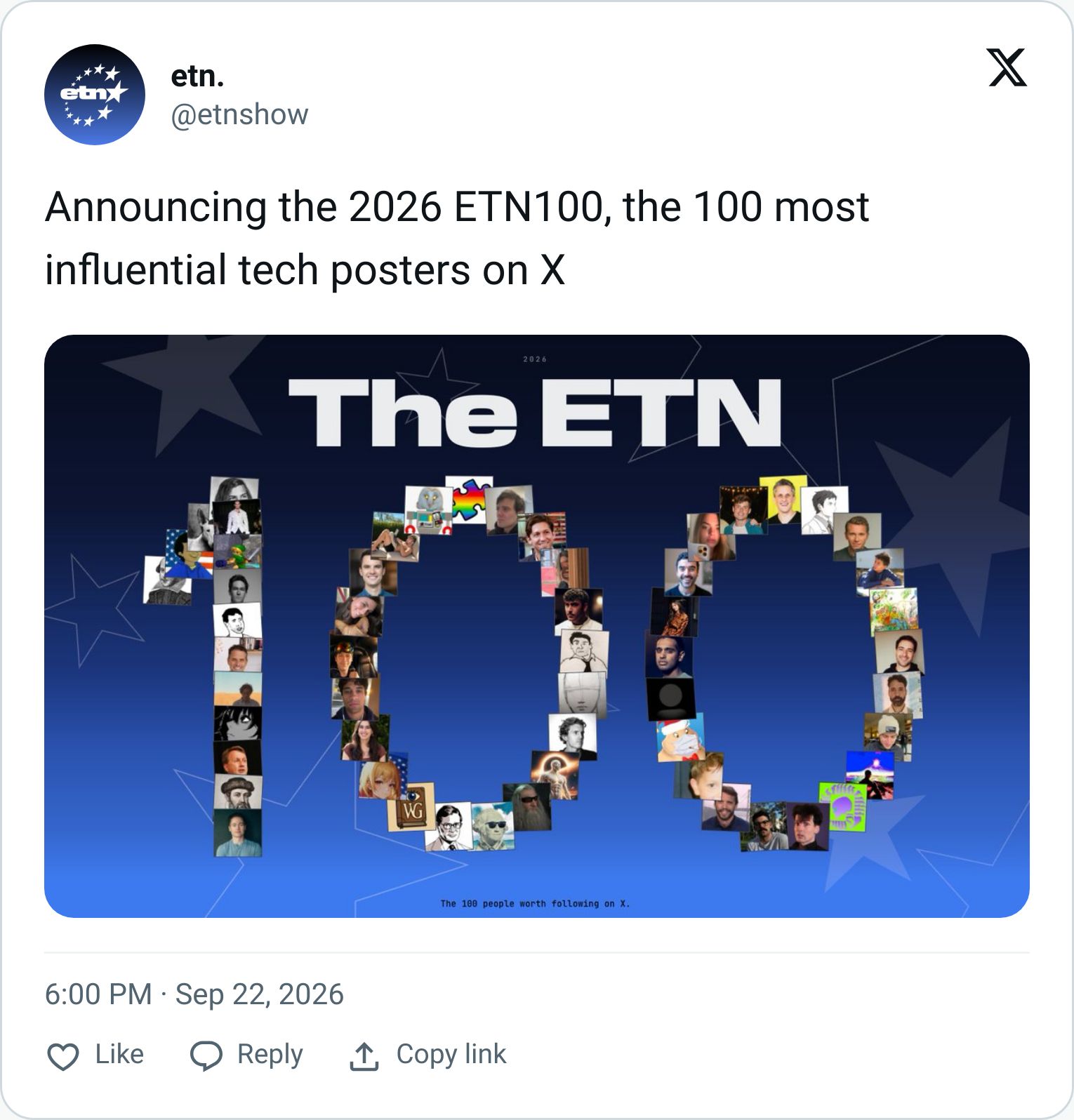
If you were scrolling the timeline yesterday, you might’ve spotted our 2026 ETN100! Shoutout to our incredible design team who compiled this and of course the legends on the list. From the ‘Gods of the Timeline’ to the ‘Top Posters’, consider it your shortcut to spending even more time on X. We’ll be breaking down some highlights and reactions in the newsletter this week…