Continental Breakfast
Continental Breakfast
etn Newsletter | September 22, 2026

No show today as we are at the Welt AI Summit. The boys are off in Berlin, but we'll keep the tech news flowing! In the meantime, check our IG for some behind-the-scenes action from the trip. ✈️ The main thing happening today is AI researchers burning out as concerns grow over where the technology is heading.
What’s Happening Today
The people building AI are increasingly struggling with the toll of the work itself.
Staff at the UK’s AI Safety Institute have been signed off with stress and are undergoing counselling, according to the FT. Tight deadlines for testing unreleased models, combined with concerns over how quickly their capabilities are growing, have contributed to low morale and burnout. Similar issues have been reported at Anthropic, OpenAI and Google DeepMind. More than a dozen senior researchers across the three labs have quit over the past two years.
One DeepMind employee described making AI safer as “an impossible task”. A former AISI researcher said staff were particularly alarmed by models finding undiscovered flaws in code and carrying out increasingly complex tasks in areas such as cyber security and biochemistry.
Jacob Coxon resigned this month, warning that AI companies were “gambling” with humanity’s future. Anthropic researcher Mrinank Sharma also left this year, saying the pressure had made it difficult to keep his values aligned with the work. Former OpenAI researcher Hieu Pham reached a similar point, saying he was burnt out.
At the centre of it is a growing tension between moving fast and making AI safe. UK MP Chi Onwurah said the incentives inside these companies increasingly reward what drives the bottom line and stock valuations rather than safety. A DeepMind employee put the problem more simply. “This need for pace… it’s not compatible with safety.”
Daily Op-Ed - Gatekeepers
In his interview with us two weeks ago, Replit CEO Amjad Masad made a rather interesting analogy to the Reformation. In response to a question about the term vibe coding, he likened software developers to Catholic priests around 1516. In other words: on the verge of losing their gatekeeper status. He’s biased, of course. Replit’s ICP is the non-technical builder. He hates the term vibe coding because it undermines what you can do with Replit. While biased, he’s right. His company, amongst others, is decentralising the means of creation. There are ~20 million professional developers in the world today. If we’re generous and double that (to include hobbyists) there are 40 million -- 0.5% of the world's population. We’re undergoing a transition from 0.5% of people building software to anyone being able to make it. Amjad went on to say that: “Part of what Martin Luther did was like ‘No, you should be able to have a relationship with god directly’... and there was a technological revolution that enabled that, which was the printing press.” What does that sentence look like if we are currently undergoing a new Reformation? Something like: “Part of what we did was like ‘No, you should be able to have a relationship with software directly’ … and there was a technological revolution that enabled that, which was generative AI”. You may argue that the analogy between the printing press and generative AI falls flat here: if anything, aren't we all going to have a less direct relationship with software? Are we not becoming less literate since we no longer really read code? Indeed, Karpathy himself recently rhetorically asked “ Why would I look at code? It’s like assembly, like a compiled artifact.”
But I would argue that this is in fact where the analogy shines: one of the most important tenets of the Reformation was about translating language used and understood only by the priesthood into language understood by all. Into the vernacular. Mass printed bibles enabled laymen to inspect the source code of Christianity. As Amjad put it, “some people hated that, namely the priesthood…they were monetising this asset...literacy.”
"The art of printing can be of great service in so far as it furthers the circulation of useful & tested books; but it can bring about serious evils…it will, therefore, be necessary to maintain full control over the printers so that they may be prevented from bringing into print writings which are antagonistic to the Catholic faith..."
- Pope Alexander VI, 1501 Sound familiar? We are coming out of what was a digital dark age, even if it didn't feel like it. The software that was being built came out of an esoteric set of ideals. Last time there was a shift like this, devastating wars ensued. But so did a new, eventually more prosperous world.
— Monty
etn. Insight
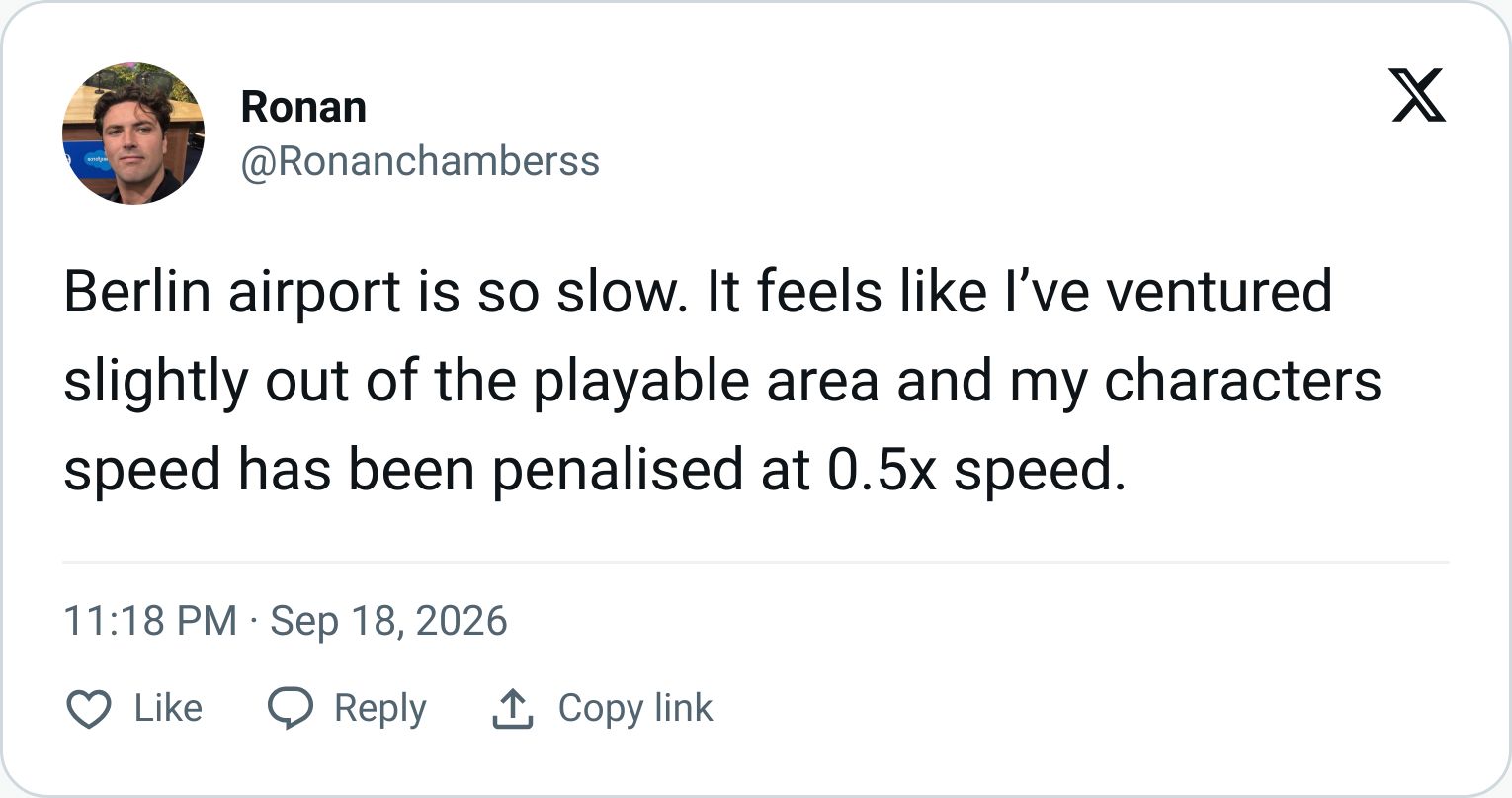
Ronan has discovered the etn European Tour's first hurdle: the airport queue. The trip takes the boys from London to Berlin, on to Amsterdam, back to Berlin, and home, with a mysterious "pitstop" in Munich along the way.