Continental Breakfast
Continental Breakfast

What a time to be live. The main thing happening today is Anthropic filing for an IPO. Quick note, today we are live from 12:30. Here's your Order of Play plus an Op-Ed on Palmer Luckey’s dogs.

12:45 PM - Jonathan Balls, Founder at Racket Club
1:00 PM - Edward Johns & Vitalis Vosylius, Co-Founders at Machenta
1:15 PM - Mark Swan, Co-Founder & CEO at Nevis
1:30 PM - Eléonore Crespo, Co-Founder & Co-CEO at Pigment
1:45 PM - Mike Bajwa & Qian Zheng, Co-Founders at Zaro
2:00 PM - Peer Richelsen, Co-Founder & CEO at Cal.com
2:15 PM - Xavier Collins, Co-Founder & CEO at Wonder Studios
2:30 PM - Bercan Kilic, Founder & CEO at microagi
2:45 PM - Madison Mills, Senior AI Reporter at Axios
What’s Happening Today
Anthropic has filed for what could be the biggest IPO in history.
The company behind Claude published its 240,000-word prospectus on Monday, ahead of a planned Nasdaq listing under the ticker ANT. Anthropic was valued at $965 billion in May, but investors now expect a valuation of between $1.5 trillion and $1.75 trillion.
The filing shows just how fast it has grown. Revenue went from $4.6 billion last year to more than $33 billion in the nine months to September. But Anthropic posted a net loss of around $81 billion in the first half of the year. More than $72 billion of that came from bonds that can be converted into company shares, which are marked up in value as Anthropic's valuation rises.
Anthropic has computing commitments worth close to $800 billion, stretching as far as 2045, and has $112 billion of cash on hand. Its founders admitted the deals "may seem irresponsibly large at first glance", but called their approach "bold but sane".
The prospectus devotes 92 pages to safety, including the possibility that AI could pose "catastrophic or existential risks to humanity". Anthropic describes how its models could resist being shut down, manipulate information or produce behaviour resembling blackmail.
Shareholders won't get much say either. A Long-Term Benefit Trust can elect a majority of the board, while the seven co-founders keep 50.1% of the voting power. The founders warn that their decisions may not always align with investors' expectations, because they'll balance profits against what they consider the public good.
We're getting into all of it on today's show at 12:30.
Daily Op-Ed — Clone Wars
Warhound launched last Thursday with $200 million from investors including Sequoia and In-Q-Tel (the CIA-backed fund). Ben Lamm, whose company Colossal "brought back" the dire wolf last year, and Palmer Luckey of Anduril are behind it. They want to clone America's best military dogs, tweak their genes and give them Anduril vests and goggles. Luckey's pitch is that "Man's best friend deserves man's best tech."
It does sound a bit creepy, but dogs have been cloned for years. China has a cloned police dog, and South Korea put cloned sniffer dogs to work at an airport back in 2009. What's new is doing it for an army. Warhound says more than 80% of its dogs come from Europe, and fewer than half are fit for service, with the US Air Force estimating the cost to train each at $60,000.
The online chatter makes this sound like a lab out of a film so I dug into how the cloning actually works. It starts with a few skin cells from the star dog (the one being copied). Scientists then take an egg from another dog, remove its DNA and swap in the nucleus from the skin cell. Electrofusion (a small electric jolt) gets it growing like a normal embryo, and a surrogate dog carries it. China's first cloned police dog, Kunxun, was carried by a beagle and delivered by C-section.
The clones aren't exact copies, because their mitochondria come from the egg donor, and like identical twins they still grow up differently. What Warhound adds is editing, cutting out genes linked to hip problems, bad eyesight and cancer before the puppy is born. Breeders have been chasing the same thing for centuries just slowly and mostly by luck.
It's very different from the Terminator dogs people have been picturing online. Better-trained, healthier dogs are hard to argue with, and we've been working alongside them for thousands of years (take the St. Bernard, which monks high in the Swiss Alps have kept as rescue dogs since the 1600s). Strip away the sci-fi and it's a very old partnership with better tech.
— Lucas
etn. Insight
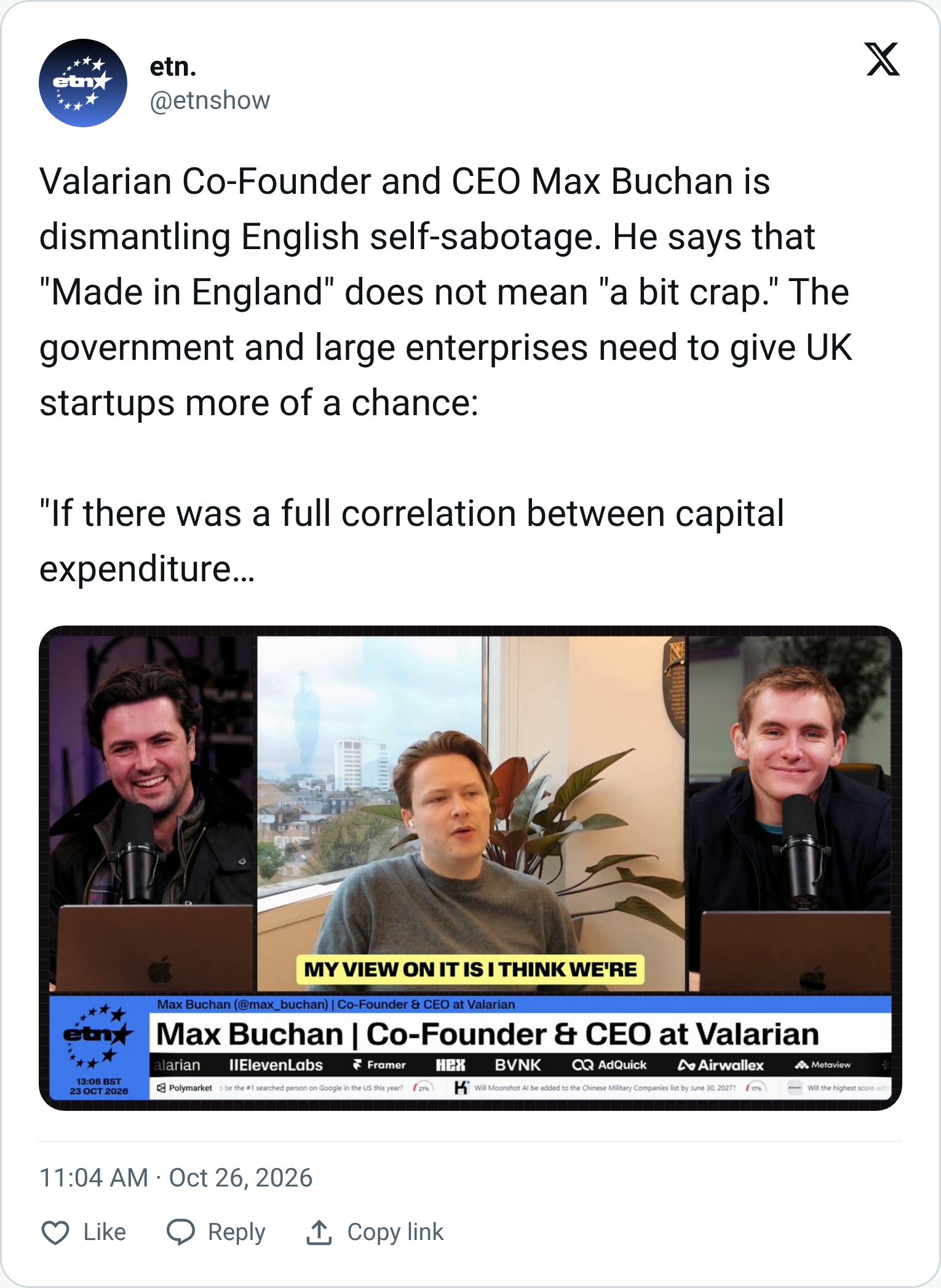
Valarian co-founder and CEO Max Buchan came on the show and argued that British startups aren't being given enough of a chance by the government and large enterprises, partly because of the stigma around things being "Made in England".
Some of Valarian's first deployments have actually been in the US, which Buchan puts down to the "ephemeral notion" that if something is made in England, "it's probably just going to be a bit crap". He's determined to disprove that narrative.
Watch the full clip below.
Continental Breakfast
Inside Anthropic's 240,000-word IPO filing
Spain eases data centre energy rules
Intel buys Israeli quantum startup Classiq
