Continental Breakfast
Continental Breakfast

What a time to be live. The main thing happening today is Elon Musk warning that many neoclouds could collapse. Live from 12-3 GMT, here's your Order of Play plus an Op-Ed from Luke on AI’s infrastructure problem.

1:00 PM - Greg Marsh, Founder & CEO at Nous
1:30 PM - Steven Glinert, Co-Founder & CEO at Sphere Semi
1:45 PM - Mackenzie Jackson, Field CTO at Aikido Security
2:00 PM - Daragh Murphy, Founder & CEO at Imprint
What’s Happening Today
Yesterday Elon Musk warned that hundreds of neoclouds could be heading for collapse.
He was replying on X to investor Chamath Palihapitiya, who had raised concerns about the problems facing the AI data centre boom. Palihapitiya pointed to legal difficulties in Texas, where securing mineral rights waivers is getting harder, alongside growing public opposition to data centres.
Musk went further, estimating that more than 200 neoclouds are heading for what he called "guppy-level death and consolidation". Investors are also questioning whether demand for AI can justify the billions being borrowed to build data centres, while the chips themselves lose value as newer generations arrive.
There are already signs of trouble. CoreWeave, which rents Nvidia computing power to companies including Microsoft and OpenAI, has around $50 billion in debt and has never turned a profit. Its shares have fallen 60% over the past year, while borrowing costs have climbed sharply.
The problems could get worse in 2027, with delays leaving expensive computing equipment sitting unused or earning too little to cover its costs. Technology research and advisory firm Gartner estimates that around 80% of neoclouds could shut down by 2030.
We're getting into all of it on today's show at 12 BST.
Daily Op-Ed — AI's Infrastructure Problem
On Sunday, Elon posted a warning on X that he expected to see “a lot of stranded compute in partially complete data centers.” It was the first real address for what’s happening in the AI data centre build out. Huge amounts of GPU compute capacity are being planned or partially built, but delays in power connections, land rights, permitting, and financing mean a lot of it will probably sit incomplete, under-utilised, or just unable to earn its cost of capital by 2027. Chamath, who owns land ready for data centres, replied explaining the dynamics between the neoclouds and hyperscalers. He said that neoclouds that build or operate AI-focused data centres and rent the capacity out are often disorganised and under-capitalised. Hyperscalers on the other hand are slow and bureaucratic. He concluded by saying that the pipeline delays will catch people off guard in 2027 meaning a lot of the capacity being bought and built will sit under-earning or idle. Musk agreed explaining how the debt markets have largely stopped lending to pure-play neoclouds that lack revenue independent of AI data-centres. If you look at SpaceX who just raised $40B in debt, they have Starlink and launch revenue that are both growing quickly and therefore investment-grade credit. Neoclouds literally exist to supply specialised AI compute (mostly Nvidia GPUs) more quickly or flexibly than the hyperscalers. The model works when money is easy and hyperscalers are signing big off take deals - they raise a bunch of debt (secured against the GPU’s and long terms customer contracts) and then build or lease the power. So firstly, financing has tightened, meaning pure AI-infrastructure plays without other cash flows are finding lenders far more selective. Secondly, power connections are a huge bottleneck for these projects. Utilities are overwhelmed, queues are long, and they’re raising the bar on capital commitments to flush out non-serious projects. What happened to the Nscale-Microsft deal was a perfect example of this. Microsoft was due to be the anchor tenant of the Loughton site but grid operators told them a connection might not arrive by 2030 so Microsoft walked away. Thirdly the offtaker contracts means they can impose heavy penalties if the neocloud misses uptime or delivery commitments. The terms collapse under the first real outage or delay and means they lose investment-grade status or a major customer can quickly make refinancing impossible. Nvidia CEO Jensen Huang is still bullish having said recently that demand for neocloud capacity is “off the charts” and some operators still have large contracted backlogs with creditworthy customers. 2027 is basically a sorting year of the 200-ish neoclouds. A lot of AI capacity won’t arrive on the original schedule or will earn less than the cost of capital so the capacity that does get built and powered will concentrate to better-capitalised operators. They’ll likely be those that already control power or land, have diversified revenue, or can raise on investment-grade terms. We’ll go through this on the show. — Luke
etn. Insight
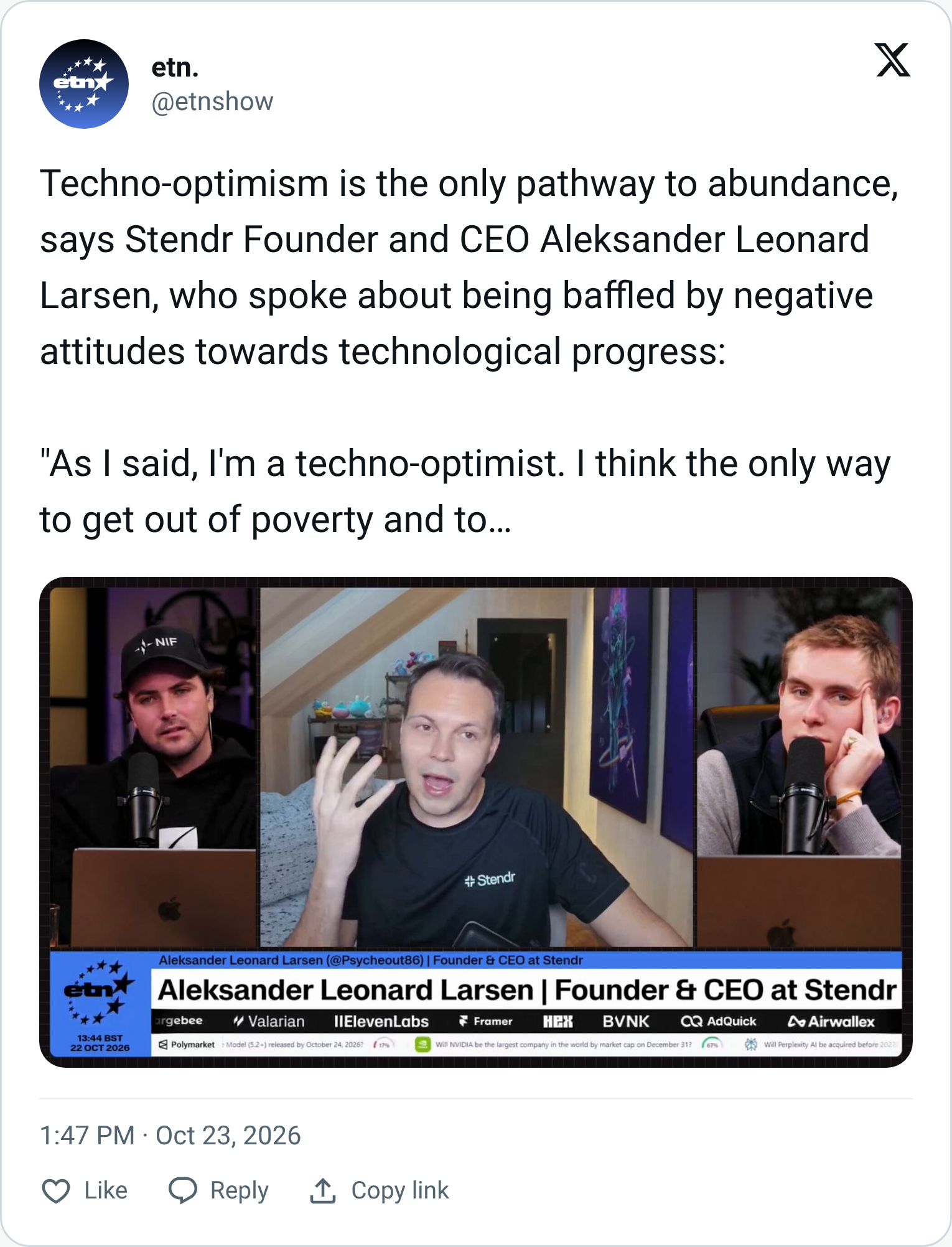
Stendr founder and CEO Aleksander Leonard Larsen can't understand why people are so negative about technological progress. He came on the show and described himself as a “techno-optimist”, arguing that technology is the only way to “get out of poverty”.
For Larsen, energy is “the missing factor”. He believes we need more technology to make existing energy more effective, develop new sources or even become a “spacefaring nation”.
Looking back at the advances of the past “20, 30, 40 years”, he finds the pessimism baffling. Larsen puts this down to pessimists having a “glass ceiling” because they haven't experienced what it's like to have “built something” themselves.
Watch the full clip below.
Continental Breakfast
The Neo-Clouds are Evaporating
London Tennis Players Lose Courts To Bots
The Social Reckoning Pulled from Cinemas
Building Slack - Salesforce Acquisition Part Two
