Continental Breakfast
Continental Breakfast

What a time to be live. The main thing happening today is the UK government weighing up whether to force data centres to invest locally. Live from 12-3 GMT, here's your Order of Play plus an Op-Ed on circular financing in the AI boom.

1:00 PM - Max Sinclair, Co-Founder & CEO at Azoma
1:45 PM - Stanislas Niox-Chateau, Co-Founder & CEO at Doctolib
2:00 PM - Barry McCardel, Co-Founder & CEO at HEX
2:15 PM - May Habib, Co-Founder & CEO at Writer
2:30 PM - Eva Barboni, Executive Director at Enterprise Britain
2:45 PM - Ramin Hasani, Co-Founder & CEO at Liquid AI
What’s Happening Today
Data centre developers could be forced to give back to local communities under new government plans.
Andy Burnham's administration is considering a "data centre covenant" that could involve direct cash payments or investment in local infrastructure. In return, developers could get priority access to the electricity grid or faster planning approval. The proposals could be announced as early as today's Budget, although nothing has been finalised.
Britain wants to triple its computing capacity to 6GW by 2030, but slow planning decisions and grid connection delays are already holding projects back. Last week, Microsoft reportedly walked away from plans for what would have been Britain's largest AI data centre because it couldn't secure power in time. AI minister Kanishka Narayan has promised a "distinctly Labour approach to British AI", arguing that the government shouldn't leave the technology to "foreign firms and foreign billionaires".
However, the plans come as opposition to data centres grows across Britain. An investigation by Spotlight on Corruption found that senior government officials met 137 businesses while developing the country's AI Growth Zones policy, compared with just two community groups and no environmental organisations.
In the US, roughly $200 billion worth of data centre developments have been disrupted or delayed this year amid public opposition. In England, councils hosting AI Growth Zones are already set to benefit financially, with the government allowing them to keep the additional business rates generated by new developments from April 2027.
We're getting into all of it on today's show at 12 GMT.
Daily Op-Ed — Round and Round
On Monday, Meta announced a $95bn share sale to fund its AI buildout, and on Tuesday Nvidia said it would buy $3bn of it. It's another case of the chip seller helping pay for the buildout that will go on to buy its chips.
This is a pattern we have been seeing. A supplier funds a customer, the customer buys from the supplier, and the supplier books a sale. The money is real, but critics including Michael Burry say it makes demand look stronger and more independent than it is.
Anthropic's IPO filing shows the extent of these deals. AMD will invest up to $5bn in Anthropic as its chips are delivered, while Anthropic spends more than $20bn on AMD systems. Google, Amazon and Microsoft will provide at least $269.4bn of cloud compute over the next decade, and Amazon could own about a fifth of Anthropic if its convertible notes fully convert.
Also on Monday, three banks and Blackstone lined up $63bn to buy Broadcom chips and lease them to Anthropic. Broadcom is protecting the lenders if those chips lose value, with peak exposure of $43bn by its own numbers.
Burry, who is betting against Nvidia, has been shouting from the rooftops (of X) about this all year. In July he wrote that Nvidia's "future revenues are majority financed in a circular arrangement", then accused it of overreaching to push "the circular spending to biblical proportions". In August he went further, citing the Bank for International Settlements: "At the chip makers, roughly 100% of announced revenue is circular."
None of this is new. In the late 1990s telecom boom, equipment makers like Lucent, Nortel and Cisco lent start-up carriers the money to buy their kit. Lucent alone committed $5.7bn of credit to customers in 2000, including $2bn to a company called Winstar.
It looked like growth. One TBR analyst at the time said of the deals: "It was more important to land the contract to show growth." Another adviser at Adventis said financing had become "table stakes" of doing business, the exact phrase Axios used for Nvidia on Monday.
Then demand slowed. Winstar went bust in 2001. By the end of 2000 nine suppliers had lent an estimated $25.6bn to carriers, and by 2003, 24 of the 30 largest listed telecom operators were bankrupt. Lucent and Nortel were left close to insolvency.
Now to be fair, today's AI boom isn't the same. Winstar was a shaky start-up borrowing to survive while Nvidia's biggest customers are mostly the cloud giants, some of the richest companies on the planet, and Anthropic has $112bn of cash. These are not companies that (currently) will struggle to pay their bills.
Still, some of Nvidia's own numbers are worth watching. Between January and July, money customers owed it rose about 63% to $63.1bn, and just five customers accounted for 70% of that. Free cash flow fell to $21bn in the second quarter from $49bn in the first, partly because Nvidia gave customers longer to pay. Morgan Stanley said Nvidia's direct credit exposure is "mostly confined" to a couple of smaller cloud firms, while Mizuho said none of this answers "how much end-user demand and economic return sits underneath all of this spending."
If customers keep paying on time and the companies buying AI, not just the ones building it, start making real money from it, Burry is wrong. If the IOUs keep piling up, he's right and that could have some very big implications for all of us.
— Lucas
etn. Insight
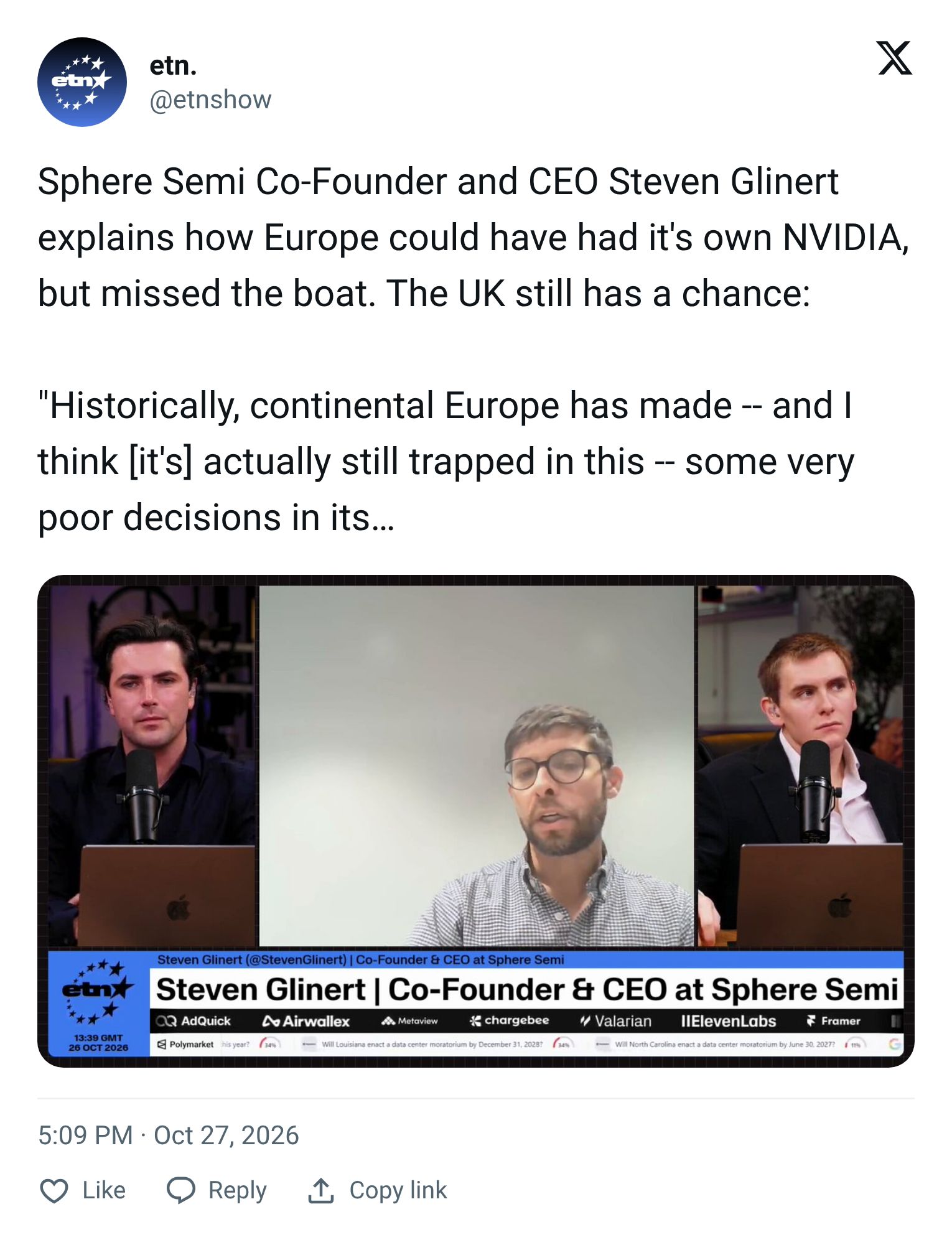
Europe could have had its own Nvidia if its chipmakers hadn't made some “very poor decisions”, according to Sphere Semi co-founder and CEO Steven Glinert.
Companies like NXP and Infineon dismissed the mobile revolution as “not for us”, choosing instead to stick with industrial and automotive chips. Even when TSMC approached them early on, their response was “We're good”.
But he thinks the UK still has a shot at producing its own competitor to Nvidia and Huawei. He points to startups doing “interesting and competitive stuff”, particularly in the inference space.
Watch the full clip below.
Continental Breakfast
OpenAI’s Diversifying with TPU’s
Anthropic Acquires Mithril Medicine
UK to Consider Forcing Data Centres to Invest Locally
The Brutal Harvard Reading Class
