Continental Breakfast
Continental Breakfast

What a time to be live. The main thing happening today is SpaceX and Tesla exploring what could be the biggest merger in history. Live from 12-3 PM BST, here's your Order of Play plus an Op-Ed about who tells your story.

1:00 PM - Boris Starkov, Growth Engineer at ElevenLabs
1:30 PM - David Eckstein, CFO at Legora
1:45 PM - Neil Chudleigh, Founder at Superwhisper
2:15 PM - John Willett, Co-Founder & COO at Rogo
2:45 PM - Alex Niehaus, Co-Founder & CEO at Helicon
What’s Happening Today
SpaceX and Tesla are exploring what could become the largest merger in history.
On SpaceX's second earnings call as a public company, Musk revealed that both firms have formed special committees to explore a merger worth more than $3 trillion on paper. If they merged, the combined company would rank behind only Microsoft, Alphabet, Apple and Nvidia. Musk thinks it's a "good idea", but admitted no terms have been agreed. As chief executive of both companies, he can't take part in the negotiations.
The merger talk came during SpaceX's earnings call, as the company reported a huge quarter. Revenue more than doubled to $14.6 billion, up 161% from a year ago, while the rocket and satellite company swung from a $1.1 billion loss to a $4.4 billion profit. Much of that growth came from its AI division, now called Super Intelligence, where revenue jumped ninefold to $7.6 billion. Anthropic, Google and others have been paying premium prices to rent its compute, with Musk claiming he's being "hounded relentlessly by every hyperscaler" for more.
Starlink, SpaceX's satellite broadband network, still generates most of the profit. Revenue climbed to $5.2 billion, with subscribers reaching 13.6 million. Musk reckons annual recurring revenue will pass $500 billion by the end of 2027 and could reach a trillion.
There's plenty else happening at SpaceX. Musk has been living in Memphis four days a week to get a supercompute cluster online and is pushing capital spending to as much as $40 billion next quarter. He also wants to launch rockets from a Louisiana duck-hunting ground by 2029 and catch Starship with mechanical arms on next month's test flight.
We're getting into all of it on today's show at 12 BST.
Daily Op-Ed — Who Tells Your Story
Sam Altman is getting a film about himself for Christmas, unfortunately for him, he's the villain.
In Artificial, Andrew Garfield plays a version of the OpenAI boss described as a “manipulative, power-hungry psychopath who lies as easily as he breathes”.
And he's not alone. Hollywood has lined up five films and series about tech founders, with Mark Zuckerberg getting The Social Reckoning, Elon Musk the Alex Gibney documentary Musk, and Elizabeth Holmes You Can See Everything.
Netflix is also releasing The Altruists, about Sam Bankman-Fried and Caroline Ellison, whom it describes as “Gen Z's Bonnie and Clyde”.
You can see the appeal. Holmes is serving an 11-year prison sentence, Bankman-Fried's crypto empire collapsed, and the others have spent plenty of time being argued about on the timeline. There are some pretty good stories in there.
But what's interesting is how Hollywood's appetite for founder stories seems to have changed. We used to get films about Steve Jobs and documentaries like Something Ventured, which treated Silicon Valley's entrepreneurs as people building extraordinary things. The latest crop seems far more interested in what happens when founders fall out of favour.
Historian Margaret O'Mara described the public's relationship with Silicon Valley as “an ardent love affair. And when you fall out of love, you fall out of love fast.” Sony film chief Tom Rothman has a simpler explanation. People increasingly feel that these companies “don't really care about them”.
I think there's something else going on here too. Tech founders have become some of the most recognisable people in the world, but most people still know remarkably little about them beyond the headlines. And when Hollywood comes along with a film, that version can stick.
Obviously, founders who break the law deserve scrutiny. Having your own YouTube channel isn't going to make an 11-year prison sentence disappear. Still, I'd be surprised if more founders don't start taking their own media much more seriously. Podcasts, videos and newsletters give them somewhere to explain what they're building without relying entirely on journalists or filmmakers.
Altman has spent years building one of the world's most talked-about AI companies. This Christmas, audiences could be introduced to him through Andrew Garfield playing a psychopath.
I'd probably want my own podcast too.
— Lucas
etn. Insight
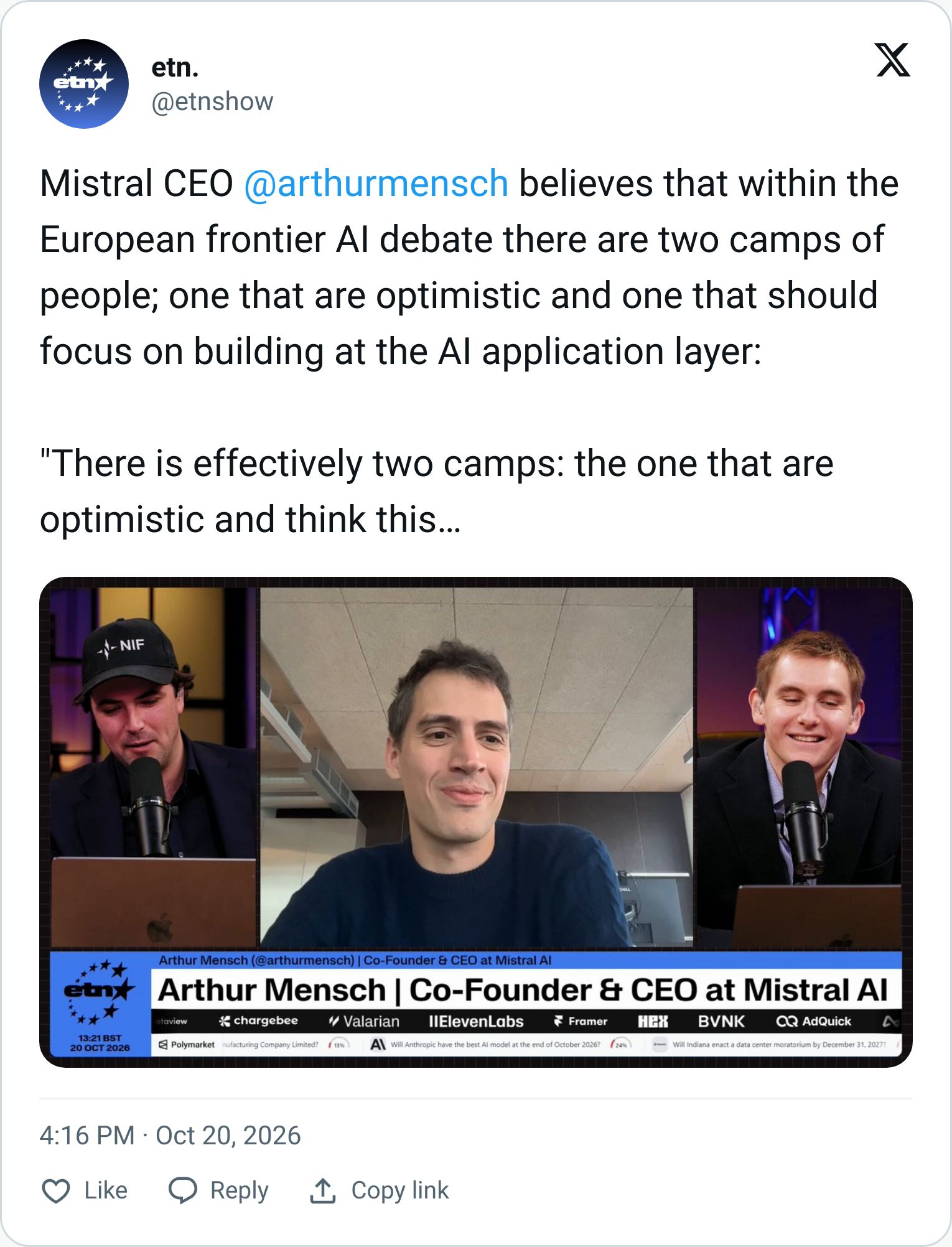
Europe being unable to build frontier AI models is an idea Mistral CEO Arthur Mensch thinks is “blatantly wrong”, as he explained when he came on the show.
He says there are “two camps” in the European AI debate. One believes Europe can compete at the frontier, while the other thinks it should focus on building AI applications instead. Mensch argues that if Europe focuses on AI applications rather than building its own frontier models, it risks being left with “very much the leftovers of the value chain”.
He also pushed back against the “pessimistic narratives” coming from outside Europe, arguing that some Europeans have started buying into them themselves.
Watch the full clip below.
Continental Breakfast
