Continental Breakfast
Continental Breakfast

What a time to be live. The main thing happening today is Altman stating his three AI endgame theories. Live from 12-3 BST, here’s your Order of Play plus an Op-Ed from Luke on Mistral.

12:45 PM - Thore Graepel, Founder at Metis Reasoning
1:00 PM - Ashley Paulus, VP, Head of Revenue, UK & EEA at Checkout.com
1:15 PM - Arthur Mensch, Co-Founder & CEO at Mistral AI
1:45 PM - Ian Rogers, Chief Human Agency Officer at Ledger
2:00 PM - Jon Kåre Stene, Partner & Co-founder at Skyfall Ventures
2:15 PM - John Acunto, CEO at Napster
2:30 PM - Ivan Burazin, Co-Founder & CEO at Daytona
What’s Happening Today
Sam Altman has warned OpenAI staff about a future where one AI company becomes powerful enough to melt everyone else's GPUs.
Altman outlined three possible paths for advanced AI during an internal discussion last week. He appeared to favour an international watchdog, modelled on the International Atomic Energy Agency, to oversee AI development and enforce safety standards. Another option, dubbed the "Demis plan", would bring the leading AI labs together under one organisation similar to Europe's CERN, providing models to cooperating countries.
The third is rather more extreme. Named after AI safety researcher Eliezer Yudkowsky, the plan imagines one company developing AI that can continually improve itself. That company could eventually gain enough economic power to "melt everyone else's GPUs".
OpenAI, Google and Anthropic are already working on a Standards Authority for Frontier AI but still disagree over who should test new models.
Meanwhile, Anthropic has reportedly proposed giving the US Commerce Department powers to halt models capable of causing more than $1 billion in damage or killing or seriously injuring over 50 people. Meta's Mark Zuckerberg and Nvidia's Jensen Huang have opposed such regulatory frameworks.
We're getting into all of it on today's show at 12 BST.
Daily Op-Ed — The Great French Hope
Last week, Co-Founder and CEO of Mistral, Arthur Mensch wrote the X article “Build or Surrender”. Today we’re having him on the show to discuss Mistral’s full-stack positioning and what it takes to build frontier AI. Arthur argued against the idea that Europe should leave frontier AI models to the Americans and the Chinese and that building at the application layer as a hedge is a fundamental mistake. “It will end up costing Europe what remains of its place in the world and lock it into a regime of economic dependence unprecedented in the history of civilizations.” He made the case that frontier models are not open protocols. The owners set the prices, restrict use, and ultimately have full control; relying on models built elsewhere leaves Europe dependent. Mistral's alternative is to build (not surrender). What Ronan, the team and I are so bullish about is Mistral's focus on moving beyond a pure model lab toward a vertically integrated European platform. They’re building their own open-weight models, some of the best in the world, and the infrastructure and control that comes with them. Something Ronan and I have celebrated a lot on the show in the last few weeks is how ambitious their goals are. They want to build the capacity itself and reverse the current market dynamic that costs businesses in Europe hundreds of millions (if not billions) a year in compute costs. Their aim is to keep the compute and therefore the returns inside Europe - controlling the infrastructure gives customers access, choice and independence. In August Arthur set a target of up to 1GW of European compute capacity by 2030, with roughly 200 megawatts underwritten by the end of 2027. Now this is incredibly ambitious, and Arthur has addressed that they’ll need to raise a lot more capital to hit that. The main logic is what’s important for us. If Europe treats frontier models and the compute as something we’re too late for, we’ll stay as a tenant. The choice as perfectly put by Arthur is to build or surrender and Mistral are one of the companies in Europe building at the frontier. See you on the show. - Luke
etn. Insight
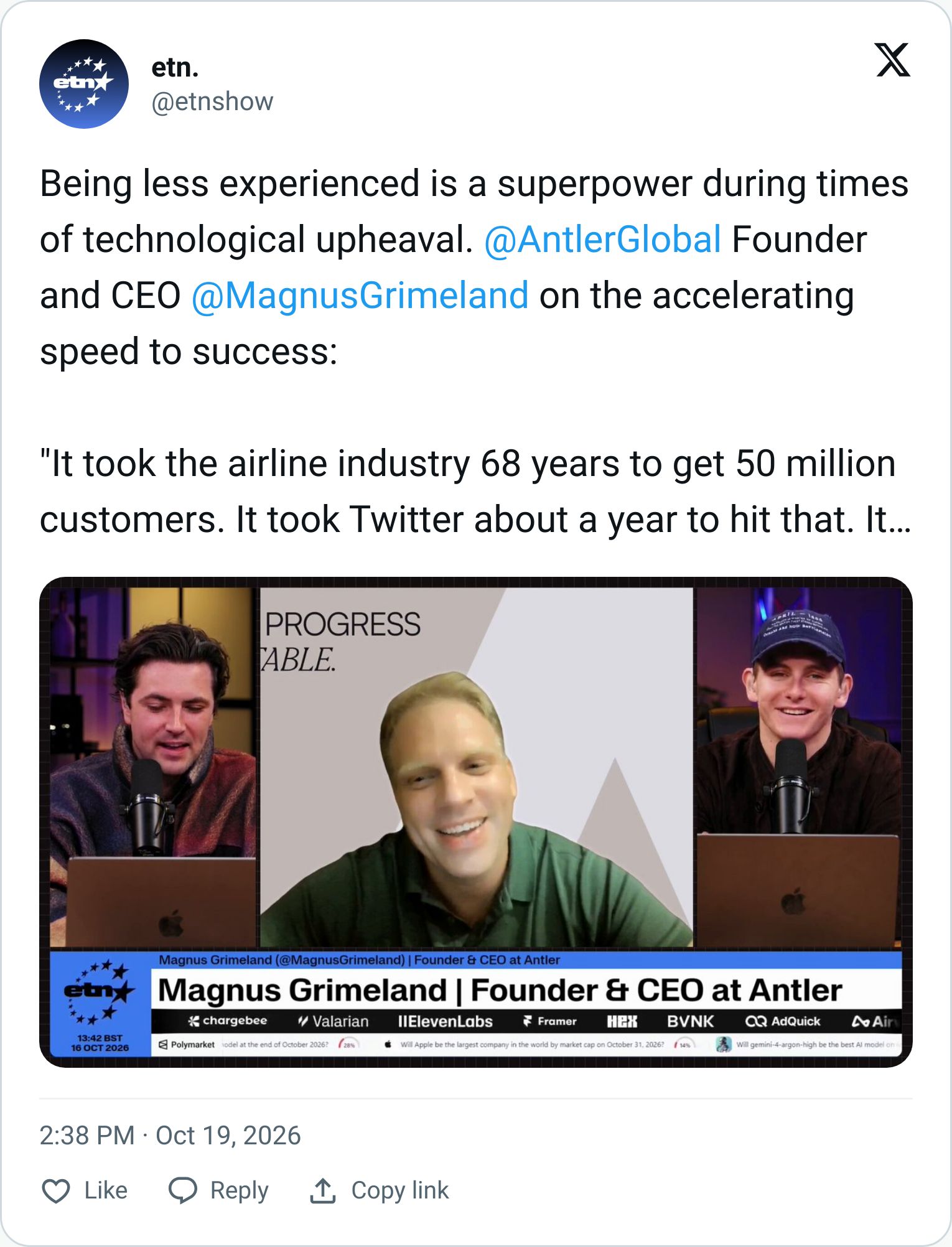
Antler founder and CEO Magnus Grimeland joined us yesterday and explained why having less experience could actually be an advantage for founders during major technological shifts.
The speed at which companies can scale has completely changed. “It took the airline industry 68 years to get 50 million customers,” he said, compared with just two days for breakthrough ChatGPT models. With product-market fit, founders can now reach their targets “much, much more quickly”.
And it's these periods of rapid technological change that Grimeland believes favour younger founders, pointing to the likes of Zuckerberg. As markets mature, “the problems that remain to be solved are more complex, and then experience matters more.” But right now, with a “blank canvas” to build on, being young and inexperienced “might actually be an advantage”.
Watch the full clip below.
Continental Breakfast
Eric Schmidt Owns 1% of Anthropic
Bugging OpenAI Worker Was Cheating with Saudi Royals
Google Execs Dismiss Fears of US AI Dominance
