
Welcome back. The main thing happening today is OpenAI's Jalapeño chip posting its first benchmark results. Live 12–3 BST. Here's your Order of Play.

WHAT’S HAPPENING TODAY
OpenAI wants to build its own way out of its reliance on Nvidia.
At the Hot Chips conference on Tuesday, the company published the first benchmark results for Jalapeño, its own inference chip built with Broadcom. Tested on SemiAnalysis's public InferenceX benchmark, it delivered 1.5 to 1.9 times more AI work per watt and up to 3.6 times lower latency than a comparable Nvidia Blackwell system. On the interactive workloads that ChatGPT actually generates, it was as much as 4.1 times faster. "The bottom line is that the results show a very, very significant performance advance over state of the art," said OpenAI hardware chief Richard Ho.
Most hardware forces a trade-off between throughput and speed. OpenAI says Jalapeño delivers high volume and low latency together by designing the chip, memory, networking and software around inference from the ground up. It's the payoff from going full-stack, and OpenAI even used its own models to help design it.
Two caveats are worth keeping in mind. The comparison is against Nvidia's Blackwell, not the newer Vera Rubin platform Nvidia is already rolling out, so the gap may look smaller by the time Jalapeño ships in volume. The tests also ran on open-weight models like DeepSeek R1 and Kimi K2.5, not the frontier systems OpenAI is known for.
Jalapeño will begin rolling out in small numbers across OpenAI’s own infrastructure late this year, before scaling up through 2027. Two more chip generations are already in development. OpenAI says it will keep buying Nvidia chips because it still needs all the compute it can get, but it is clear that it wants to reduce its dependence on them.
We're diving into all of it on today's show at 12 BST.
YESTERDAY’S MOMENT
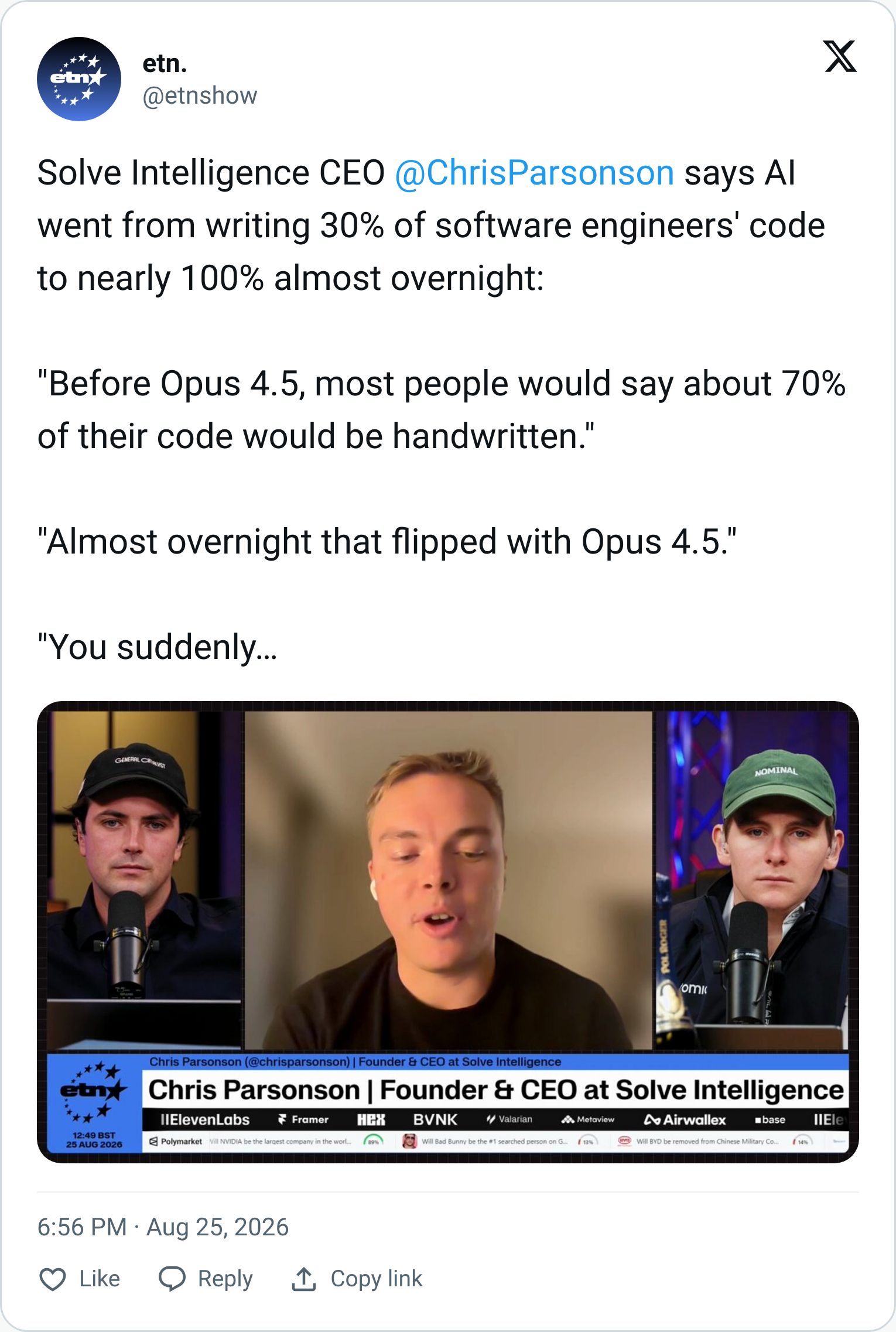
Solve Intelligence CEO Chris Parsonson came on the show to discuss how AI is taking over coding.
Before Opus 4.5, he said, most engineers still wrote the bulk of their code by hand. Then, almost overnight, that flipped. "You suddenly saw software engineers having essentially 100% of the code being written by AI."
Other fields aren't moving quite as fast. "Legal workflows are a little bit more complex. With legal workflows, particularly in patents, every single word matters." The precision that a patent demands, he argued, is exactly what makes it harder to hand over to a model, for now.
Watch the full clip below.
YESTERDAY’S BANGER OF THE DAY

VIEWER TAKES


Join us live,
Luke & Ronan
etn is made possible by Airwallex, Eleven Labs, Polymarket, Framer, Base, Metaview, Hex, BVNK and Valarian