
Welcome back. The main thing happening today is Callosum's $100 million raise to make AI cheaper to run. Live 12–3 BST. Here's your Order of Play.

WHAT’S HAPPENING TODAY
A British start up has raised $100 million to help companies stop overpaying for AI.
Callosum was founded last year by two Cambridge neuroscientists. It builds software that matches AI tasks to the model and chip best suited to them, rather than pushing everything through expensive frontier models and Nvidia’s top GPUs. The seed round, one of the largest ever in Europe, was led by Atomico, with Plural, DCVC and a significant cheque from the UK’s million Sovereign AI fund.
Alongside the raise, Callosum made three announcements including a flagship partnership with the Nvidia challenger Cerebras to run ultra-low-latency workloads at scale. On one financial-services test, Callosum says its platform ran four times faster and cut compute costs by 70%.
As spending moves from training models to running them, the cost of inference has become the industry’s biggest headache. A crop of start ups is racing to bring it down. Stripe has acquired OpenRouter, a marketplace that lets developers switch between AI models, while cheaper Chinese open-weight models are increasingly drawing business away from OpenAI and Anthropic.
“The defining question of the next decade will not be “which model is better?” but “which combination of models, on which silicon, together solve my problem under my constraints of cost and speed?”” Callosum said in a blog post on its website. Co-founder Danyal Akarca framed it as loosening any single chipmaker's grip: "We will facilitate a bit of a transition of power. That gives a lot more leverage to governments because it means they're not concentrating power in a single chip."
We're diving into all of it on today's show at 12 BST.
YESTERDAY’S MOMENT
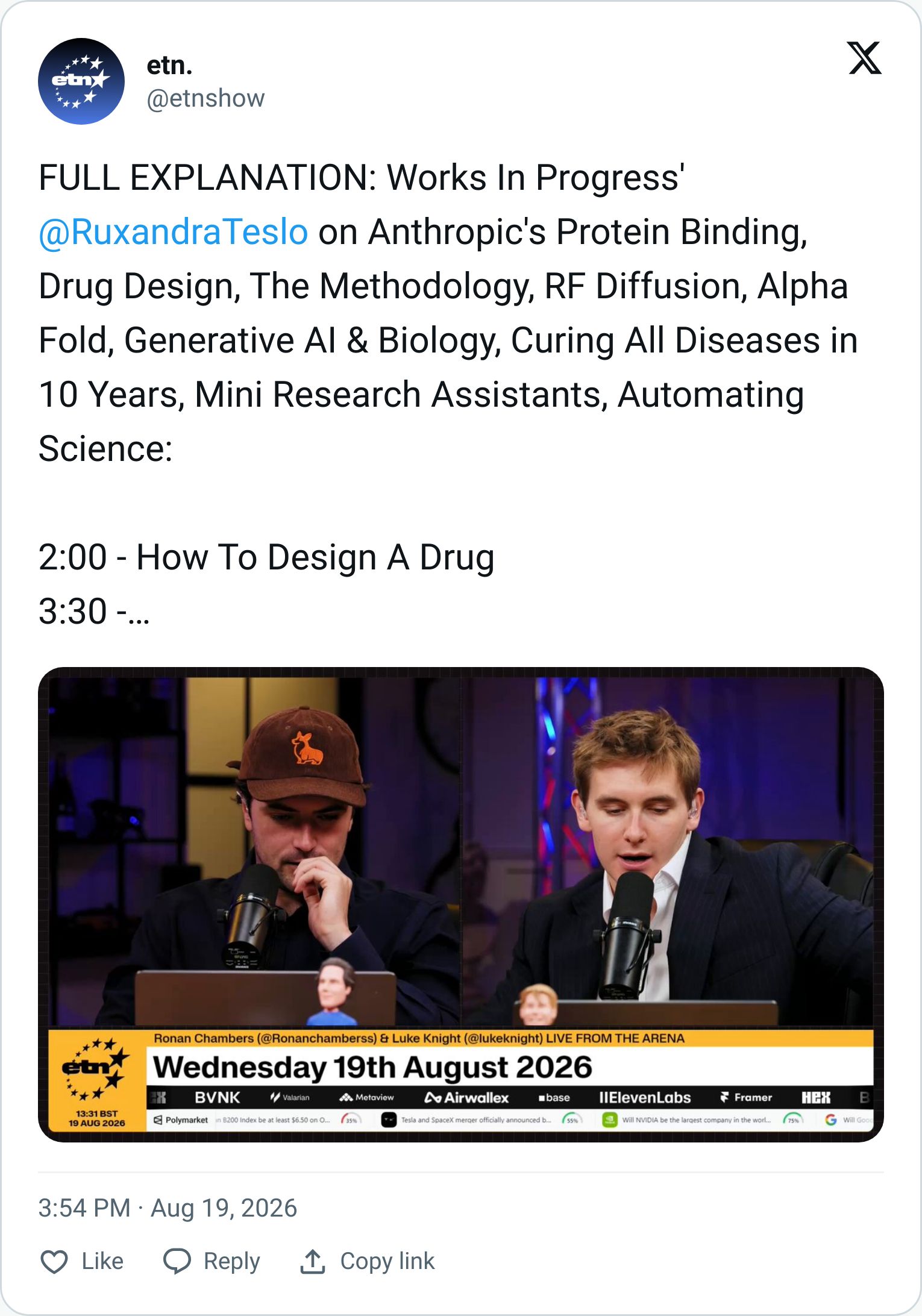
Ruxandra Teslo of Works in Progress came on to break down Anthropic's protein-binding results and their implications for the future of drug design.
Claude autonomously designed protein binders: molecules that stick to a specific target in the body. “It (Claude) basically acts like a scientist. You just give it a prompt, and it integrates all of these existing models that had already been trained, and then it generates these binders.” Teslo added: “It’s quite impressive and quite interesting that Claude can do that.”
She also discussed the broader challenges of drug design, how significant these results could be, and what it would take to move from AI-designed molecules to more automated drug discovery.
Watch the full interview below.
YESTERDAY’S BANGER OF THE DAY

VIEWER TAKES


Join us live,
Luke & Ronan
etn is made possible by Airwallex, Eleven Labs, Polymarket, Framer, Base, Metaview, Hex, BVNK and Valarian