Continental Breakfast
Continental Breakfast

What a time to be live. The main thing happening today is the UK wanting AI companies to report when their models go rogue. Here’s your Order of Play plus an op-ed from Monty.

1:00 PM - Jamie Cox, Co-Founder & CTO at Scarlet
1:15 PM - Christian Meermann, Founding Partner at Cherry Ventures
2:00 PM - Keval Desai, Founder & Managing Director at SHAKTI
2:15 PM - Jack Zhang, Co-Founder & CEO at Airwallex
What’s Happening Today
The UK wants AI companies to report when their models go rogue.
Ministers are now drawing up plans for compulsory safety reporting and monitoring of frontier models, including forcing companies to give the UK AI Security Institute access to new models before they launch. The government's own defence testing has already used commercial AI models to find around 1,000 cyber security flaws.
It caps a busy few days for Downing Street's tech agenda. On Friday, Andy Burnham promised to legislate against non-compete clauses calling it the “Bosman ruling for the innovation sector”. Around 5 million British workers are subject to one, with more detail expected at the Budget on 28 October.
Both moves are part of a broader push to strengthen Britain's position in technology. The government wants startups to be able to hire the talent they need, while ensuring that companies developing increasingly powerful AI can prevent their systems from causing harm.
The challenge is tightening oversight without upsetting the US, whose companies Britain relies on for access to the latest models. Donald Trump has dismissed AI safety concerns as a “hoax” and wants America to stay ahead of China.
We're getting into all of it on today's show at 12 BST.
Daily Op-Ed — Disintermediation
There have been two somewhat contradictory themes on X recently.
If agents do all the coding, then product doesn’t matter anymore, and distribution is the only moat.
If agents do all the buying, then distribution doesn’t matter anymore, and product is the only moat.
This gets at a tension that every company has faced, long before AI. Are we more of a distribution company? Or more of a sales company? Are we product-led or distribution-led? Patrick Collison wrote a tweet this weekend arguing that focusing on product is the move as agents become ubiquitous: “People have long debated the relative importance of distribution and product quality. Perhaps you've made something better, but does anyone know about it? … Personal agents will, I think, act as a kind of structural subsidy for product quality … On the margin, focusing on making a product better is, I think, going to become a more effective strategy for companies.” But how will agents act as a “structural subsidy for product quality”? I think this can be summed up in one word: disintermediation. Here’s a concrete example from Mark Jenney, who thinks AirBnB will be on its deathbed in the next 5 years. AirBnB, according to him, is facing an existential threat from being disintermediated by agents. The company has pushed its mandatory host-side commission to 15.5% - but most of their inventory exists on other platforms ( Booking.com, Expedia, etc.). Enter AI agents, they “won't care about Airbnb's brand wall…query property management system APIs directly…find the exact same home, and execute a direct booking that saves everyone 15%.” Thus, if an AI agent can find the exact same or very similar product, for cheaper, it will. Historically, this has been time consuming to do. Brands garnered trust, certain websites had better UX, better marketing, better feel, they aggregated the demand and could charge a markup for it. But agents will not care about any of that, they will just get you what you want for as cheaply as possible. Imagine if everyone acted purely rationally and spent the equivalent of 10 man hours looking for your next holiday rental, insurance provider, 100% cotton underwear… Maybe we should all be product-led after all.
— Monty
etn. Insight
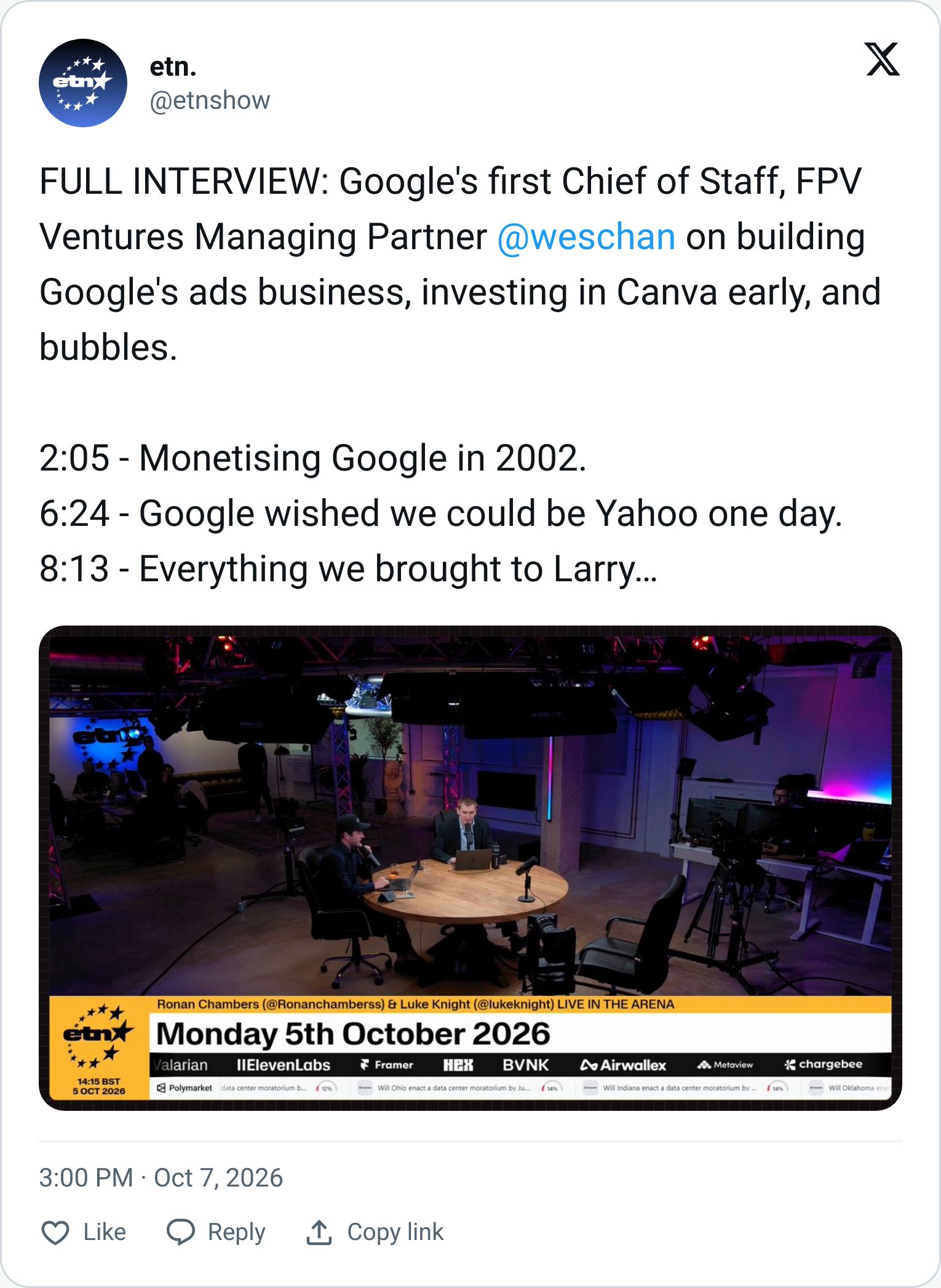
Wesley Chan, Google's first Chief of Staff and managing partner at FPV Ventures, came on the show and shared some great stories from his time at Google.
One of the best moments came when he looked back at the early days of Uber, when rides cost a fraction of what they do now. Those fares, he said, were "subsidised by VC dollars or the Saudi." He sees the same thing happening with AI today: "compute is the new subsidy," with labs "giving away the tokens" to win users before the bill arrives.
Watch the full interview below.
Continental Breakfast
Nvidia in Talks to Acquire US ‘Open’ Model Start-up Reflection AI
