Continental Breakfast
Continental Breakfast

What a time to be live. The main thing happening today is Anthropic shares sliding. Live from 12 GMT. Here’s your Order of Play plus an Op-ed from Lucas on the policy behind Sweden's unicorns.

12:45 PM - Mel Morris, CEO & Co-Founder at Corpora.ai
12:50 PM - Ilona Logvinova, Chief AI Officer at HSF Kramer
1:15 PM - Tristam Constant, Co-Founder & CEO of Agon
1:30 PM - Eugen Alpeza, Co-Founder & CEO at Edra
1:30 PM - Kaushik Subramanian, Partner at EQT Ventures
2:15 PM - Hugo Renaudin, CEO at Ulys
What’s Happening Today
Anthropic's record-breaking IPO hasn't stopped the sell-off in AI stocks.
The company behind Claude made its Wall Street debut on Thursday in the biggest IPO in history, with shares jumping 17% on their first day. Investors had hoped it might steady the rest of the AI trade. The Wall Street Journal wrote that maybe AI's "pure-play juggernaut would press the big reset button. That didn't happen."
By Friday the shares had slipped to within five cents of their $83 listing price, before closing at $88.91, and the wider market went with them: the Nasdaq is now 18% below its recent peak, and the S&P 500 has entered correction territory.
The listing and a private placement led by Nvidia and Google brought total proceeds to around $119.5 billion, including shares sold by existing investors. Anthropic's bankers also exercised an option to sell another $12.2 billion of shares after just one day of trading. Former Bank of America executive Craig Coben questioned the timing, arguing that waiting could have helped support the share price.
Anthropic isn't alone. AI cloud provider CoreWeave has lost 70% of its value since its 12-month high, and Oracle and Alphabet have also taken heavy hits. If this is a bubble, history isn't encouraging: leading stocks in the six biggest bubbles of the past 50 years fell by a median of 67% after they burst.
We're getting into all of it on today's show at 12 GMT.
Daily Op-Ed — The Home PC Reform
Sebastian Siemiatkowski grew up in a family that couldn't afford a computer.
Then, in 1998, the Swedish government let employers give staff home computers tax-free through their salary. As he later told Reuters, his mother bought one the very next day. Around 850,000 computers were distributed, reaching roughly a million people.
Siemiatkowski taught himself to code at 16.
At 23 he co-founded Klarna.
Around the same time, Sweden was getting high-speed internet into homes much faster than most of Europe (in 2001, Sweden had 5.4 broadband subscriptions per 100 people, compared with just 0.6 in the UK). Spotify's Daniel Ek remembers having government-funded fibre in 1997, which he called "a glimpse at the future".
When a whole generation gets cheap computers and fast Wi-Fi, kids start building things. Stockholm is now home to 33 unicorns, and its startup ecosystem is worth $252.5bn. Fortune says that's more unicorns per head than any city outside Silicon Valley.
Sweden's early successes also gave the next generation of founders something to build on. Klarna co-founder Niklas Adalberth told us back in October that Skype's sale to eBay was a turning point.
"Suddenly everyone realised that, hey, we can actually start a sizeable company out of Sweden."
Antler's Tobias Bengtzén echoed this on the show last year explaining how Lovable's founders grew up surrounded by Stockholm's success stories, so building a unicorn doesn't feel out of reach.
It turns out Sweden's tech boom owes less to any grand plan than to the unglamorous work of getting ordinary families online and the success that compounded from it.
In the UK, the help often exists but doesn't reach the people who need it. Discounted broadband schemes are available, yet fewer than 9% of eligible households use them. Nominet estimates that two million young people in the UK still don’t have a laptop or desktop at home.
Bringing back a Swedish-style tax break, where staff get a home computer through their pay, would cost the Treasury roughly £130 for every £300 laptop, or around £260m for two million of them. That’s less than National Highways spent on a single planning application for the Lower Thames Crossing. Nearly thirty years after Sweden helped families like Siemiatkowski’s get their first computer, that seems a small price to pay for a shot at the next Klarna.
— Lucas
etn. Insight
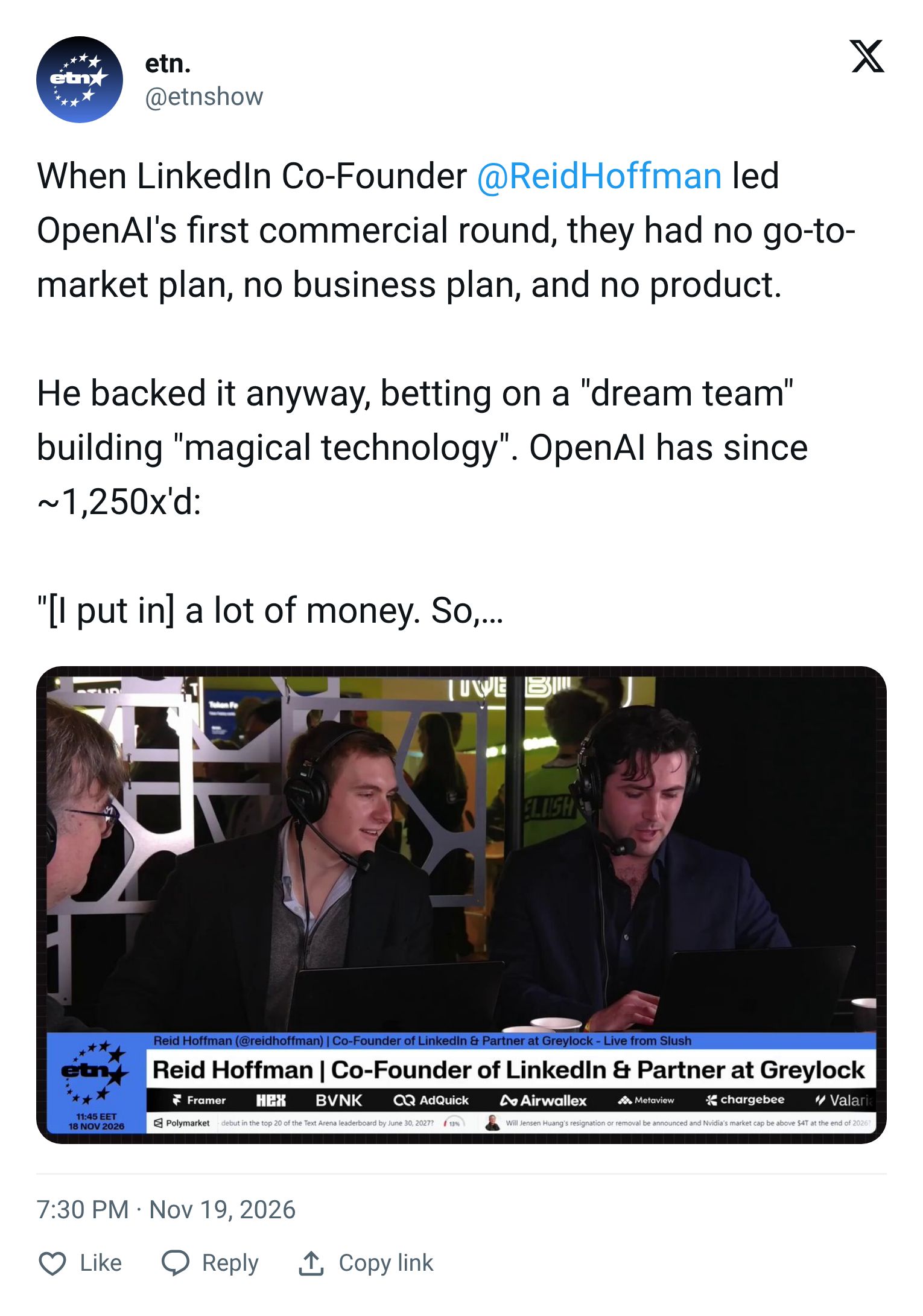
At Slush, LinkedIn co-founder Reid Hoffman told us how he led OpenAI's first commercial funding round, even though the company had no product, no business plan and no go-to-market strategy. His investment has since grown roughly 1,250x in value.
Hoffman had already supported OpenAI through philanthropic donations when Sam Altman approached him about raising commercial funding. Asked to lead the round, he said yes straight away, telling Altman, "I know what amazing technology you guys are building."
As Hoffman put it, "You're really taking a shot on this stuff," but looking at the people involved, he thought, "Yeah, yeah, this has to work."
Watch the full clip below.
Continental Breakfast
Anthropic’s IPO Performance So Far
Alexandr Wang - Superintelligence is Arriving
Anthropic Solves Riemann Hypothesis
