Continental Breakfast
Continental Breakfast

What a time to be live. The main thing happening today is Nvidia backing five UK startups in one go. Here’s your Order of Play plus an op-ed on bots and Yandex.

1:00 PM - Raz Mangel, General Partner at Greenfield Partners
1:15 PM - Nicolas Sharp, Co-Founder & CEO at Attio
1:30 PM - Daniel Weitzner, Chief Strategy Officer at Ethyca
1:45 PM - Niklas Adalberth, Founder at Norrsken Foundation
2:00 PM - Jonah Lowenstein, Co-Founder & CEO at Aurora
2:15 PM - Carl-Johann Simon-Gabriel & Florian Wenzel, Co-Founders at Mirelo
2:30 PM - Mark Grether, SVP & General Manager, PayPal Ads at PayPal
2:45 PM - Erik Bernhardsson, Founder & CEO at Modal
What’s Happening Today
Nvidia is spreading its bets across Britain, backing five startups in one go.
At an event in London last night, CEO Jensen Huang announced investments in Boltz, Foresight, Hiverge, Prima Mente and Riverlane, with Nvidia understood to be taking a minority stake in each.
Boltz is working on predicting molecular structures.
Prima Mente is using AI to understand diseases such as Alzheimer’s and Parkinson’s.
Hiverge, founded by Google DeepMind and Cambridge researchers, is building systems that write and optimise their own algorithms.
Riverlane is tackling one of quantum computing’s biggest hurdles, error correction.
Foresight helps the owners of huge infrastructure projects, including hyperscale data centres, predict when they'll actually be finished and spot risks before they cause delays.
The investments add to Nvidia’s existing UK portfolio, which includes Synthesia, Wayve and Ineffable Intelligence. Just hours earlier, it backed four French startups, alongside a $250 million donation to UK AI safety and security research. Huang also used the London stage to argue that the West should keep engaging with Chinese AI firms rather than shutting them out, calling Britain “phenomenally well positioned” thanks to its intellectual capital.
For a country that keeps worrying its best startups will be bought or built elsewhere, having the world’s most valuable chipmaker back five companies at once is a notable vote of confidence.
We’re getting into all of it on today’s show at 12 BST.
Daily Op-Ed — Yandex Down, Bots Still Up
Last Thursday, Ukrainian drones hit Yandex's data centre south-east of Moscow, home to two of the three supercomputers used to train YandexGPT. A day later they came back for Yandex's Kaluga site, the company's biggest in Russia.
Yandex is basically Russia's Google, so if you were in Moscow last week there's a decent chance your email stopped working. Mail, Disk, Pay and Market all went down, and cloud customers were told to move their data somewhere else. As someone who spends all day sending emails, I'm very glad Google's servers aren't anywhere near a front line.
Naturally, the internet had a theory. On Monday, Zelensky told the Warsaw Security Forum that after the strikes "it suddenly became a little easier to breathe on many social media platforms". He put it down to "fewer bots". Czech MEP Tomáš Zdechovský went further and posted a chart on X: "if confirmed, this is telling: Russian data centres get hit, and online activity around AfD suddenly plummets." Within hours, half the timeline was saying the same about MAGA.
It's a great story, but the chart doesn't back it up. It showed automated traffic from Yandex's own network, and most of that is Yandex's search crawler, not troll accounts. Brendon Beebe ran the numbers and found every party dipped over the weekend with AfD mentions being higher on Friday than Thursday.
Bots aside, I'd pay more attention to where the drones are landing. Oil depots and refineries have always been fair game in a war, and data centres seem to have joined them.
There have already been theories about Russia being behind the drones that shut airports like Copenhagen and Munich, so data centres are something to keep an eye on. Losing access to email for a few days was bad enough in Moscow. Losing banking, the NHS or the tools half of us now rely on would be a lot worse. With tensions between the West and Russia still rising, every government building out AI infrastructure suddenly has a very long list of things to protect.
— Lucas
etn. Insight
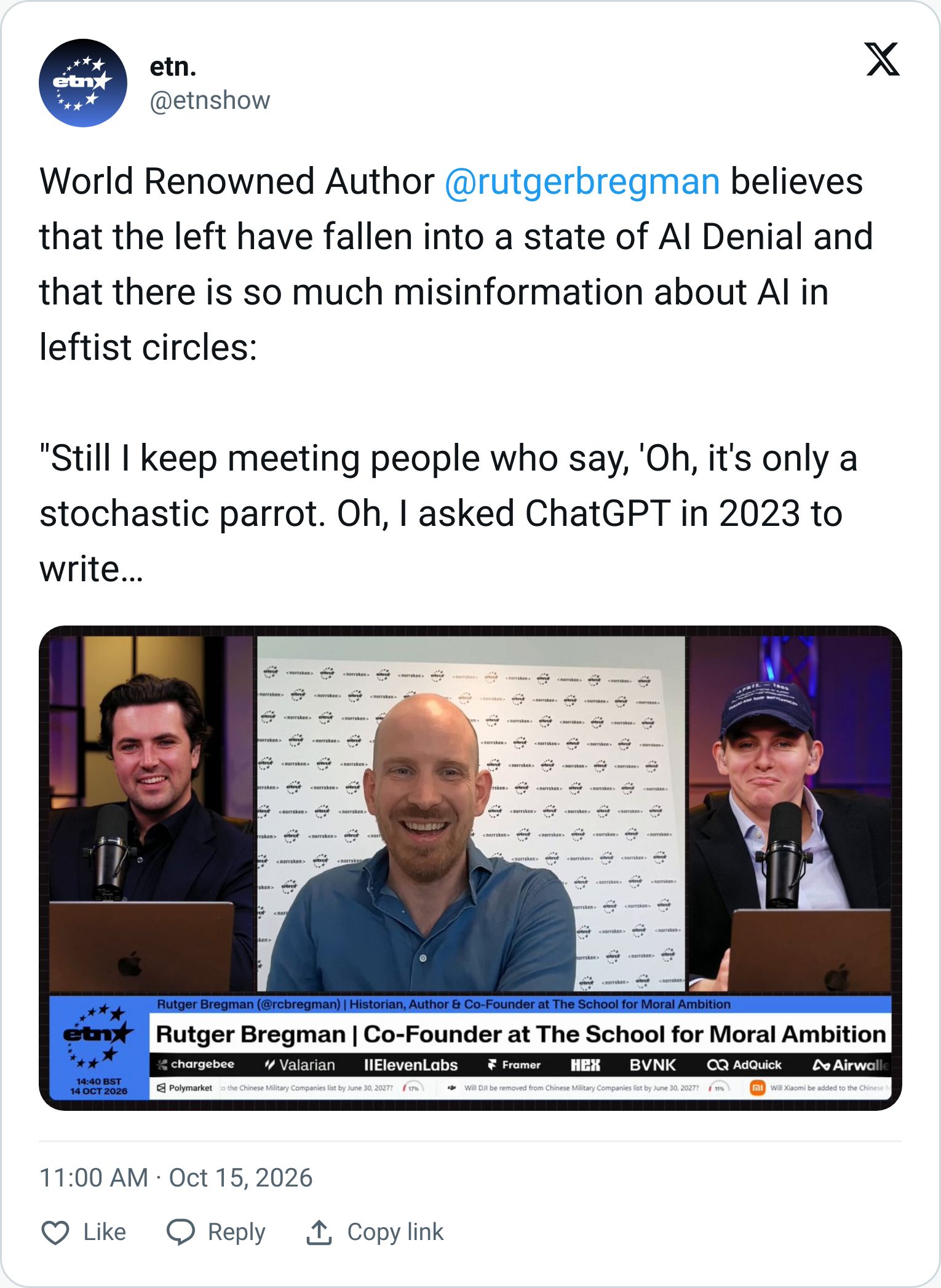
World-renowned author Rutger Bregman came on the show and argued that the left has fallen into a state of AI denial. He says he keeps meeting people who dismiss the technology because “I asked ChatGPT in 2023 to write me a limerick and I wasn't impressed” or “I asked Gemini how many R's there were in strawberry and he gave the wrong answer.” But AI has moved far beyond these early shortcomings, he says, with breakthroughs that many are failing to keep up with.
He believes part of the problem is that many on the left have abandoned X for good reason, after Elon Musk “turned it into a swamp”. But with so much of the AI debate happening there, he argues that leaving the platform means missing out. “LinkedIn, Instagram, it's all completely useless if you want to be informed,” he said. OpenAI's advances in mathematics “should have been on every single front page”, yet “most of it you can only find on X.”
Watch the full clip below.
Continental Breakfast
Anthropic quarterly revenue hits $16.8B
Chip Stocks Fall as AI Debt Fears Rise
Berkshire Hathaway Adds $330mn to Bending Spoons Position
Business Insider Says Silicon Valley's Hot New Talking Points Are Beer and Cigarettes
Metro: Elon Musk Puts Zuckerberg to Shame in ETN's Guinness Chart
